That is not a proven fact verifiable by solid evidence. This is merely my own opinion based on firsthand observations. Let me explain why I developed that hypothesis. But first, some background information.
Last night around 11:00 a freak thunderstorm blew through the Washington D.C. area. One minute I was watching television, the next the trees around my house were blowing violently, the loose items on my back deck were being thrown about, and I could hear the wind slamming into the aluminum siding. The lights flickered, went out, and came back on several times. The rain was heavy but brief, and within twenty minutes the storm had passed on and everything had returned to normal.
This morning, after breakfast, I went out to do some errands. I was surprised to find that half my city was without power, including about seventy-five percent of the traffic lights. But I was dumbstruck at how people were reacting.
Now mind you, this was just a freak thunderstorm. There were no tornadoes, or sustained hurricane-level winds, or massive flooding. And except for one poor woman in Maryland who died in her bed when a tree toppled over onto her house, there were no fatalities. But the way people acted out there, you would have thought it was the end of the world.
Intersections with non-working traffic signals were insane. It seemed as if everyone forgot that broken traffic signals are to be treated as four-way Stop signs. I don't know who was worse -- the drivers who blew through these intersections without even slowing down, or the timid ones who just sat there, too afraid to move. I came upon one intersection on a back road where five cars blocked five lanes because the traffic signal was out and no one knew how to handle it. On the main road, all common sense seemed to have left people along with the electricity. I saw one driver cruising along in the far-left breakdown lane, and another one stopped in the middle of four lanes reading a map.
The police were out in force, but they seemed to be uncoordinated. At none of the intersections were they directing traffic; they were merely blocking off lanes and forcing drivers to go into directions they didn't want to go. Actually, I must correct myself since that statement is inaccurate. I did find a cop at one intersection with working signals who was directing traffic against the light cycle and causing more confusion than anything else. He would have been much off going west several blocks to the major intersection without signals where no one knew how to respond.
On my way home I turned to the news channel on the radio (I had plenty of time to listen since the police kept redirecting me farther and farther away from my home) and shook my head. According to WTOP, those gas stations with power had lines panicky people desperate to fill up on gas, and some grocery stores were reporting increased traffic as people stocked up on essentials.
By the time I got to within a mile of my house me and several others like me (read either "tough, confident individuals who go into battle mode during a crisis and don't panic under pressure" or "arrogant, self-centered buttheads") were ignoring the craziness around us and just trying to get to where we were going.
What really bothered me was the inability of people to cope, both the civilian and the law enforcement. Did the academy train the police how to direct traffic (stop all traffic, let one lane proceed at a time, repeat until the intersection is clear) or did they just not want to be bothered? Would the driver who stopped in the middle of a four-lane highway to consult a map have done the same thing if the situation was "normal"? (Sadly, being northern Virgina, the answer to that could be yes.) This was a bright, sunny (and hot) day following a thunderstorm that did
minimal damage. I shudder to think what would have happened if the dead came back to life (or some other, but not as much fun, natural disaster had occurred).
With regards to the incident above where five cars blocked five lanes because no one knew what to do, the Bostonian in me let out a string of invectives (I'm at my most creative when I'm combining blasphemies and insults into single descriptive phrases) and long, loud blares on the horn. The writer in me realized that if this was the zombie apocalypse, me and everyone in my vehicle would be overrun and devoured or forced to set out on foot into the hordes of the living dead because of the actions of others.
So now I'm sitting home, venting my frustrations (and pretending it's a blog posting) surrounded by my pets who are staring at me with that "I thought you were going out?" look. After doing some writing, I'll probably spend the night in front of the television. But you can be sure I'll be watching Doomsday Preppers and taking notes.

Saturday, June 30, 2012

Sunday, June 24, 2012
PAIN IS PERSONAL by Lane Adamson
I'd intended to write a brief but enlightening discourse on werewolves, and why they still rock, this week. Then I got a kidney stone and got distracted.
This was my second go-round with kidney stones. The first time, the doctor at the emergency room told me that, although I was presenting with the requisite symptoms, I didn't seem to be evincing enough pain to have a kidney stone: specifically, I wasn't crying or curled up in the fetal position (or even begging for painkillers). I politely told him that I had a high tolerance for pain--and when the tests showed I did indeed have the stones, he apologized and paid respect to my stoicism.
Anyway, after this flare-up, I got to thinking about what one might call the Three Pillars of Fear: the Unknown, Pain, and Death. I don't know if this concept is original to me or not (I thought of it on my own, but that means very little); but I think you'll find that you can shoehorn pretty much all horror storytelling into one or more of those three categories.
I'll probably deal with a broader overview of the subject at another date, but I haven't had time to percolate on it yet. For now, let's look at Pain.
Pain is the most personal of fears--even more than Death, if you think about it. Death, at least, has finality; they can only kill you once (generally speaking). Pain, on the other hand, can go on and on almost indefinitely, and (unless clumsily administered) is almost guaranteed not to kill you... but you might wish it would.
That's a powerful thing.
I tend to avoid the more outre movies of the horror genre--they used to be called slasher films (the Friday the 13th series, for example), now they've morphed into what's being called "torture porn" (the Hostel films and others). I'm a sensitive sort; I don't enjoy watching people get hurt for the sake of watching people get hurt--even if they're promiscuous, drug-using co-eds who somehow "deserve" it.
Still, just as films like Invasion of the Body Snatchers or Them! helped audiences cathartically deal with their fears of the Unknown, while Dracula and Frankenstein bring us face-to with Death (with a subtext of the Unknown), I suppose I can see a certain value in films like those referenced earlier for subliminally subrogating one's pain.
Or, maybe you're all just a bunch of sick bastards.
This was my second go-round with kidney stones. The first time, the doctor at the emergency room told me that, although I was presenting with the requisite symptoms, I didn't seem to be evincing enough pain to have a kidney stone: specifically, I wasn't crying or curled up in the fetal position (or even begging for painkillers). I politely told him that I had a high tolerance for pain--and when the tests showed I did indeed have the stones, he apologized and paid respect to my stoicism.
 |
| Me and Jesse ain't got time for pain |
Anyway, after this flare-up, I got to thinking about what one might call the Three Pillars of Fear: the Unknown, Pain, and Death. I don't know if this concept is original to me or not (I thought of it on my own, but that means very little); but I think you'll find that you can shoehorn pretty much all horror storytelling into one or more of those three categories.
I'll probably deal with a broader overview of the subject at another date, but I haven't had time to percolate on it yet. For now, let's look at Pain.
Pain is the most personal of fears--even more than Death, if you think about it. Death, at least, has finality; they can only kill you once (generally speaking). Pain, on the other hand, can go on and on almost indefinitely, and (unless clumsily administered) is almost guaranteed not to kill you... but you might wish it would.
That's a powerful thing.
I tend to avoid the more outre movies of the horror genre--they used to be called slasher films (the Friday the 13th series, for example), now they've morphed into what's being called "torture porn" (the Hostel films and others). I'm a sensitive sort; I don't enjoy watching people get hurt for the sake of watching people get hurt--even if they're promiscuous, drug-using co-eds who somehow "deserve" it.
 |
| I don't like to watch. |
Still, just as films like Invasion of the Body Snatchers or Them! helped audiences cathartically deal with their fears of the Unknown, while Dracula and Frankenstein bring us face-to with Death (with a subtext of the Unknown), I suppose I can see a certain value in films like those referenced earlier for subliminally subrogating one's pain.
Or, maybe you're all just a bunch of sick bastards.
Monday, June 18, 2012
A Belated Father's Day Blog by Scott M. Baker
The reason I'm posting this two days late is because I didn't actually come up with the posting until late Sunday and didn't get a chance to draft it until just now.
Any one who follows my blog knows that I'm an old Monster Kid going back to the 1970s, and that my mother was the one who enabled my passion for the dark side. But the person I've never talked about is my father, the one who kept my horror habit fed for all those years.
As far back as I remember, my father and my maternal grandfather had a ritual that they never strayed from: every Saturday morning they would get up early and go out for breakfast. As I got older, they began taking me with them. I loved it, and not just because I got to spend time with my dad and grand dad, which was great. But after breakfast, my father would drive me around in a quest for monster memorabilia.
I can still remember impatiently sitting at the table in the greasy little diner in downtown Lynn (the habitual breakfast spot), already having wolfed down my English muffin and endlessly fidgeting in the booth waiting for the real fun to begin. Such was the curse of having a tiny child's stomach. Only after the men had finished off their eggs, bacon, home fries, toast, and bottomless cups of coffee would the excitement (for me, at least) really begin.
The first stop was always Cal's News in downtown Lynn, not far from the diner. Once in Cal's, I would make a beeline straight for the entertainment section and thumb through the stacks looking for the latest treasure: The Monster Times, Eerie or Creepy magazine, the dozens of other pulp monster mags that thrived back in the good old days, or the mother lode of all finds -- the latest issue of Famous Monsters of Filmland. I could barely wait to get back to the car to start thumbing through them and marvel at the images inside.
Then it was off to the Don Elder's in Chelsea, a small business run by a kindly, elderly gentleman out of an old garage. Mr. Elder sold mostly 35mm cameras and 8mm camcorders and movie projectors, but for me the attraction was his vast collection of Castle Films. These were 12-minute, black-and-white, silent versions of horror and Sci-Fi movies. Each one came in a box about six inches square, usually with a reproduction of the movie poster emblazoned across the front. They only offered a tantalizing taste of the original movie, but in the days before video tapes, they were the only way to be able to see your favorite movies without having to wait for them to be played by the local cable access television station at one in the morning. (I still have my entire collection of them safely tucked away in a closet.) After that, it was a quick run to the hobby shop in Malden where I would pick up the latest Aurora monster model, and then back home. On a good day, I would make it back in time to catch Creature Double Feature on WLVI Channel 56.
And never once did my father complain about schlepping me around the North Shore every Saturday. I'm sure he always pictured me as a Marine like himself and his brother Bob (who fought on Okinawa). But he never complained that instead he got stuck with a geek little kid who liked monsters. (Although I did enjoy watching war movies with him, so that surely softened the blow.) Like my mother, he has always been very supportive of me in everything I've done, and to this day he still gets on the phone when I'm chatting with the family to tell me he's proud of me.
But those days are drawing to a close. Over the past few years, my father has been fighting a losing battle with a series of mini-strokes that have caused Alzheimer-like symptoms. He's slowly slipping into the real-life horror that accompanies the deterioration of one's mind, and every time I go home to visit I recognize him a little less. Soon all that will be left of my father is the memory of who he once was.
So before it gets too late to say it, thanks for feeding the addiction, Dad. You helped make me the man I am today.
 |
| My mother and father on their 50th wedding anniversary. |
As far back as I remember, my father and my maternal grandfather had a ritual that they never strayed from: every Saturday morning they would get up early and go out for breakfast. As I got older, they began taking me with them. I loved it, and not just because I got to spend time with my dad and grand dad, which was great. But after breakfast, my father would drive me around in a quest for monster memorabilia.
I can still remember impatiently sitting at the table in the greasy little diner in downtown Lynn (the habitual breakfast spot), already having wolfed down my English muffin and endlessly fidgeting in the booth waiting for the real fun to begin. Such was the curse of having a tiny child's stomach. Only after the men had finished off their eggs, bacon, home fries, toast, and bottomless cups of coffee would the excitement (for me, at least) really begin.
The first stop was always Cal's News in downtown Lynn, not far from the diner. Once in Cal's, I would make a beeline straight for the entertainment section and thumb through the stacks looking for the latest treasure: The Monster Times, Eerie or Creepy magazine, the dozens of other pulp monster mags that thrived back in the good old days, or the mother lode of all finds -- the latest issue of Famous Monsters of Filmland. I could barely wait to get back to the car to start thumbing through them and marvel at the images inside.
Then it was off to the Don Elder's in Chelsea, a small business run by a kindly, elderly gentleman out of an old garage. Mr. Elder sold mostly 35mm cameras and 8mm camcorders and movie projectors, but for me the attraction was his vast collection of Castle Films. These were 12-minute, black-and-white, silent versions of horror and Sci-Fi movies. Each one came in a box about six inches square, usually with a reproduction of the movie poster emblazoned across the front. They only offered a tantalizing taste of the original movie, but in the days before video tapes, they were the only way to be able to see your favorite movies without having to wait for them to be played by the local cable access television station at one in the morning. (I still have my entire collection of them safely tucked away in a closet.) After that, it was a quick run to the hobby shop in Malden where I would pick up the latest Aurora monster model, and then back home. On a good day, I would make it back in time to catch Creature Double Feature on WLVI Channel 56.
And never once did my father complain about schlepping me around the North Shore every Saturday. I'm sure he always pictured me as a Marine like himself and his brother Bob (who fought on Okinawa). But he never complained that instead he got stuck with a geek little kid who liked monsters. (Although I did enjoy watching war movies with him, so that surely softened the blow.) Like my mother, he has always been very supportive of me in everything I've done, and to this day he still gets on the phone when I'm chatting with the family to tell me he's proud of me.
But those days are drawing to a close. Over the past few years, my father has been fighting a losing battle with a series of mini-strokes that have caused Alzheimer-like symptoms. He's slowly slipping into the real-life horror that accompanies the deterioration of one's mind, and every time I go home to visit I recognize him a little less. Soon all that will be left of my father is the memory of who he once was.
So before it gets too late to say it, thanks for feeding the addiction, Dad. You helped make me the man I am today.
Saturday, June 16, 2012
WHERE'S MY CAKE? A FATHER'S DAY RUMINATION by Lane Adamson
I was an early, precocious reader. I vividly recall sitting by my mother's side, exclaiming over the colorful, delightful imaginings and images of one Dr Seuss. But though Mom taught me to read--a debt beyond repayment--it was my Dad who taught me to love reading. Funny thing is, I don't thing he had the slightest idea that he was doing it.
Daddy is an inveterate and unrepentant reader; he's more likely to be found reading than any other single activity, including eating, watching television, or sleeping. Given a brief pause in any other action, he'll break out a book. (Of late, since his driving has been curtailed by a defibrillating pacemaker that went a little gollywonkers, he has even more reading time.)
As memory serves--and this was back in the early 1970s, when dinosaurs roamed the earth and there were no personal computers or wireless phones--I discovered Daddy's bookcase when I would have been about nine. It sat in the hallway between the master bedroom and my own, and was loaded with a rich, random assortment of adult texts. The contents evolved constantly. Daddy kept open accounts at no less than three used bookstores in the area, possibly more--one simply wasn't sufficient to satisfy his appetites.
I started with the Louis L'Amour westerns. This budding young Texan read with wide-eyed wonder the tales of rugged individuals building a country from scratch; Ruble Noon, Cullen Baker, the Tinker, and the Sacketts were heroes to me the way Davy Crockett had been to an earlier generation.
Daddy is an inveterate and unrepentant reader; he's more likely to be found reading than any other single activity, including eating, watching television, or sleeping. Given a brief pause in any other action, he'll break out a book. (Of late, since his driving has been curtailed by a defibrillating pacemaker that went a little gollywonkers, he has even more reading time.)
As memory serves--and this was back in the early 1970s, when dinosaurs roamed the earth and there were no personal computers or wireless phones--I discovered Daddy's bookcase when I would have been about nine. It sat in the hallway between the master bedroom and my own, and was loaded with a rich, random assortment of adult texts. The contents evolved constantly. Daddy kept open accounts at no less than three used bookstores in the area, possibly more--one simply wasn't sufficient to satisfy his appetites.
I started with the Louis L'Amour westerns. This budding young Texan read with wide-eyed wonder the tales of rugged individuals building a country from scratch; Ruble Noon, Cullen Baker, the Tinker, and the Sacketts were heroes to me the way Davy Crockett had been to an earlier generation.
 |
| Ride 'em, blog boy! |
In the fifth grade, we had a class reading assignment; our choices were The Lion, the Witch, and the Wardrobe, by CS Lewis, or The Hobbit, by JRR Tolkien. I remembered seeing The Hobbit on daddy's bookshelf, so I picked that one--and high fantasy became an integral part of my life. I spent the entire summer of my tenth year wading through the Lord of the Rings trilogy, and revisited it annually for several years thereafter. I still go back to it every so often, and never fail to pick up something new from that rich tapestry (like the time in my thirties when I realized that Tolkien was telling us his own version of Ragnarok, and/or Wagner's Ring Cycle--that was a moment of clarity like few I've had in my life).
(I sometimes have a road-not-taken conversation with myself regarding the direction my life might have gone had I chosen Lewis's Narnia books instead of Tolkien, but we'll never know.)
Also on the bookshelf, and soon being devoured by me, were assorted series of action-adventure novels published by Pinnacle books: Don Pendleton's Executioner; The Destroyer by Sapir and Murphy; the blood-and-guts gore of the Edge westerns by "George G Gilman" (in fact, the very British Terry Harknett). These were probably really rather too adult (especially the last) for one of my tender years, but my parents were remarkably trusting of my judgment--and I didn't turn out too warped.
 |
| Later republished as WITHOUT REMORSE by Tom Clancy |
Somewhere along the way, I picked up a hardback on that bookcase with the slightly unsettling title of Dangerous Visions, edited by a guy with the fuddy-duddy name of Harlan Ellison. That mattered not a whit; I soon found myself lost in the smoky gambling halls of Fritz Lieber's "Gonna Roll the Bones" and the disturbing, psychosexual dysfunction of Philip José Farmer's "Riders of the Purple Wage," among so many others. (Later, I discovered Ellison had written one of my favorite Star Trek episodes, and his stature grew in my eyes, if not in real life--but that's another story.) I dove headfirst into the speculative fiction pool after that; Asimov, Bradbury, Clarke, and Heinlein were then my constant companions for most of the next twenty-five or so years of my life--until they started dying off or at least not writing so much.
The divorce came and went, and reading, in a large way, helped me through it. As a child, I didn't understand why our family unit was broken. But I could abscond into another world and not worry about it. Reading time became something that I shared with Daddy, those every-other-weekend visits--a strangely isolated companionship, but it worked for us. I say isolated because when we read, we're gone. We don't hear you talking to us. We don't see what's going on around us. We're involved in our books. But as we were reading together, it bonded us.
I do this with my wife, sometimes, now. It's very quiet and relaxing, the reading time. (As an aside: If you ever want to make a new acquaintance at a moment's notice, just go--alone--someplace busy, like a diner or a bus depot, and open up your book. Someone will almost always start talking to you within minutes.)
I don't read so much now as I used--too little free time, too much tired. But I've never forgotten the lessons I learned from that bookcase of Daddy's, some forty years ago: the best stories are straightforward, involving, and active. I try to keep these things in mind in my own writing, when I can find time for it; I want to write things my Dad would like to read.
If he's enjoyed this entry, I've done well.
Happy Father's Day, Daddy--and thanks for the books.
 |
| It's Father's Day, and I've got my cake! |
Tuesday, June 12, 2012
PROMETHEUS, Or How I Learned To Manage My Disappointment and Enjoy the Lesser Things in Life by Scott M. Baker
No, this is not another review of Ridley Scott's Prometheus. Believe me, I could rant on for pages about what I thought was wrong with the movie. But I first want to express my key complaints about the key flaws in this film. [Begin spoiler alert] Why is it that every movie in the franchise feels the need to have an android that, in the end, gets ripped apart with copious amounts of white fluid spraying everywhere and innards that contain small white globes? Why does every encounter with the aliens have to be the result of someone/some entity wanting to militarize the species for profit or exploit it for other selfish motives? And why does Ridley Scott feel the need to include a twist ending that turns our understanding of the aliens' origin on its head? [End spoiler alert]
I bring this up only because it bears on a topic of conversation I've heard a lot lately at conventions and on the Internet about whether fans are killing the horror genre (and for purposes of this post I'm including Sci-Fi in that category) by watering it down. That argument is being made by people who don't fully understand the genre.
I cite Prometheus as an example. This movie has been hyped for months as Ridley Scott's epic prequel that would be the crowning of the Alien franchise and show us the origins of the species. I found Prometheus to be all hype. Sure, the special effects were nominal and Charlize Theron has now been enshrined in my pantheon of epic bad guys. But overall, I found the movie to be a blockbuster rehashing of old themes.
Now before everyone skips to the end of this post and starts commenting on how I wouldn't know a good movie if it hit me in the face with 3D, I am using this movie to emphasize my point that there is a general consensus among those who think that if a movie is artistic it somehow brings respectability to the genre, and anything else detracts from it. That's where I totally disagree.
It's the schlock that makes the genre so vibrant.
Frankenstein (1931) and Dracula (1931) are both recognized as a classic movies that set the trend for horror until the 1930s, yet Monster Kids and fans loved all the various permutations of these films, from Ghost to Houses to Abbott and Costello. The Thing from Another World (1951) and Day the Earth Stood Still (1951) are the quintessential extra-terrestrial movies, yet we got just as much of a thrill from being invaded by the giant carrot from It Conquered the World and the Green Slime. Nightmare on Elm Street and Friday the 13th scared the shit out of us so much that we continued going back through endless sequels until our two favorite modern monsters finally squared off. And two of the most well-known names of classic 1950s horror, Roger Corman and William Castle, based their entire careers on a proliferation of cheap B-grade movies, and we love them for it.
The same holds true for fiction. For every Stephen King, Clive Barker, and Richard Matheson novel, there are hundreds more than fill the bookshelves, many by authors few people have heard of.
Does it mean that fans' standards have sunk so low that we're strangling our own genre? Hell no. It means we embrace the genre as a whole, from the phenomenal to the laughable. We don't ask for an Academy Award or a Bram Stoker winner with every movie or book. That would become boring after awhile. What we ask for is honesty. I love the SyFy Channel original movies not because of their quality but because they are purposefully made to be like a B-grade drive-in film. I love the occasional zombie book with little plot or character development as long as there's at least one gore-laden zombie on every page.
What I don't like are pretentious movies or novels that pawn themselves off as masterpieces but only live up to the expectations of the critics who do not know better.
I bring this up only because it bears on a topic of conversation I've heard a lot lately at conventions and on the Internet about whether fans are killing the horror genre (and for purposes of this post I'm including Sci-Fi in that category) by watering it down. That argument is being made by people who don't fully understand the genre.
I cite Prometheus as an example. This movie has been hyped for months as Ridley Scott's epic prequel that would be the crowning of the Alien franchise and show us the origins of the species. I found Prometheus to be all hype. Sure, the special effects were nominal and Charlize Theron has now been enshrined in my pantheon of epic bad guys. But overall, I found the movie to be a blockbuster rehashing of old themes.
Now before everyone skips to the end of this post and starts commenting on how I wouldn't know a good movie if it hit me in the face with 3D, I am using this movie to emphasize my point that there is a general consensus among those who think that if a movie is artistic it somehow brings respectability to the genre, and anything else detracts from it. That's where I totally disagree.
It's the schlock that makes the genre so vibrant.
Frankenstein (1931) and Dracula (1931) are both recognized as a classic movies that set the trend for horror until the 1930s, yet Monster Kids and fans loved all the various permutations of these films, from Ghost to Houses to Abbott and Costello. The Thing from Another World (1951) and Day the Earth Stood Still (1951) are the quintessential extra-terrestrial movies, yet we got just as much of a thrill from being invaded by the giant carrot from It Conquered the World and the Green Slime. Nightmare on Elm Street and Friday the 13th scared the shit out of us so much that we continued going back through endless sequels until our two favorite modern monsters finally squared off. And two of the most well-known names of classic 1950s horror, Roger Corman and William Castle, based their entire careers on a proliferation of cheap B-grade movies, and we love them for it.
The same holds true for fiction. For every Stephen King, Clive Barker, and Richard Matheson novel, there are hundreds more than fill the bookshelves, many by authors few people have heard of.
Does it mean that fans' standards have sunk so low that we're strangling our own genre? Hell no. It means we embrace the genre as a whole, from the phenomenal to the laughable. We don't ask for an Academy Award or a Bram Stoker winner with every movie or book. That would become boring after awhile. What we ask for is honesty. I love the SyFy Channel original movies not because of their quality but because they are purposefully made to be like a B-grade drive-in film. I love the occasional zombie book with little plot or character development as long as there's at least one gore-laden zombie on every page.
What I don't like are pretentious movies or novels that pawn themselves off as masterpieces but only live up to the expectations of the critics who do not know better.
Sunday, June 10, 2012
From Triffids to Zombies
I blame my
love of zombies on triffids.
Until I was
twelve years old, my reading list was pretty tame. It consisted of classics like the Prisoner of
Zenda, horse stories such as My Friend Flicka and cute mysteries like Trixie
Belden. My deepest desires were to
uncover a jewellery heist in the neighborhood and to own a horse that ran like
the wind (courtesy of Black Stallion).
And then I
read The Day of the Triffids. A meteor
that renders the world blind.
Flesh-hungry walking plants that roam the streets. What a dream combination!

I was
captivated by the book’s many haunting scenes, some of which have been copied
in movies like 28 Days Later. The scene
when the man wanders down London’s deserted main street? Straight out of the pages of Day of the
Triffids.

There is another scene which
haunts me every time I read the book. The
hero hears a young girl, somewhere in the city, singing a melancholic song. Her sweet voice travels clearly through the
deathly still streets. It is a haunting image
because the hero, and the reader, knows she is doomed. I could go on, but suffice it to say, the book
changed my reading list overnight.
Out went
the Gnid Blytons and in came John Wyndham’s and Andre Norton’s post-nuclear
apocalyptic landscapes. I was entranced
by the idea of living in a world transformed by disaster and having to rely on
my own skills to survive. For that is
the appeal of the apocalyptic and disaster genre, isn’t it? When we read these books, we imagine
ourselves in the same situation but, of course, our character, steely determination
or unusual skill set gives us an advantage over our unfortunate fellow man.
Zombies are
just another subset of this genre. Instead
of nuclear bombs, viruses or earthquakes, there are mindless, hungry automatons. It helps that they spread faster than juicy gossip. I adore this form of the apocalypse because it requires the hero or
heroine to be intelligent to stay
alive, not just be in the right place at the right time. One of the reasons my book is placed in the midst
of a zombie apocalypse is because it provides the perfect scenario to test my
heroine, a mother desperate to protect her young family, and discover what
qualities she possesses which set her apart from others.
 |
| It would be nice to be armed to the teeth in a zombie apocalypse but , in the meantime, a kickass attitude helps a lot! |
My passion for science fiction and disaster stories, in particular, has remained steadfast for over thirty years. So, when
you come down to it, I have to thank the triffids for leading me to write my
first novel. The mindless feeding
machines of The Day of the Triffids have morphed into the mindless feeding machines of
Dead Tropics. Zombies may roam the streets instead of triffids but the spirit of the Wyndham's book is still present in the zombie books of today. It is in the modern hero's struggle to retain their humanity in the face of terrible choices; it is present when they discover inner strength they did not know they had, and, most especially, it is in their determination to fight to the death for the people they love
Every
decade or so, I feel the urge to dust off my copy of The Day of the Triffids and lose
myself in it again. I have a feeling it
is that time of the decade again...
Sue Edge
VAMPIRES ARE NOT DEAD... I MEAN, NOT EXACTLY... by Lane Adamson
There's been a lot of talk lately about how zombies are the "new" vampires; the formerly top-shelf undead have been co-opted by the tween set and relegated to sparkly irrelevance.
I respectfully call BS.
While the pop-culture phenomenon that is the zombie/ghoul, the rotting risen dead returned to feast on the flesh of the living, has reached new heights, I don't think we can say the vampire has been thoroughly staked just yet. Let's discuss.
The vampire first rose--if you will--to international pop-cultural prominence with the publication of Bram Stoker's Dracula in 1897 (if not with John Varney's The Vampyre a little earlier). A new peak was reached, then surpassed, with the archetypal performances of the elegant Bela Lugosi in Stoker's iconic role on first stage, then screen.
Christopher Lee made Dracula a snarling, brawny predator in the Hammer films from the 1950s through the 1970s. Louis Jordan, Frank Langella, and even Jack Palance all essayed the part with some success in the 70s. Since then we've also seen such notables as George Hamilton, Gary Oldman, and Gerard Butler sink their teeth into the part (we'll overlook Mel Brooks for the sake of this discussion).
Also, let's not forget our off-Dracula vampires: (just-departed) Jonathan Frid as the elegantly menacing Barnabas Collins; the tragically super-fly William Marshall as my main man Blacula; Geraint Wyn Davies in the Forever Night TV series; a younger, pre-Bones David Boreanaz as Angel; Alex O'Loughlin as Mick St John on Moonlight; and of course, Tom Cruise, Brad Pitt, and Antonio Banderas as Anne Rice's immortals in 1994's Interview with the Vampire. Oh, yeah, and that aforementioned, scintillant, Pattinson guy.
(There's also that True Blood thing on HBO, but I don't subscribe and so can't comment intelligently.)
Anyway, are we detecting a common thread yet? I'll spell it out for you: all of these gents brought the sexy. I say that with the honest appraisal of a happily married Texas boy without a homoerotic bone in his body; just appreciating the facts.
Zombies may be a lot of things, but they've got all the charm and charisma of used toilet paper. (No offense intended to any coprophiliacs in the audience.) Almost no one wants to be one--though many of us might feel as though we are, in a spiritual sense; stripped of our last human vestige by an increasingly egocentric society seemingly intent on self-cannibalization.
Vampires, on the other hand, like Clara Bow, have it: that indescribable combination of threat, power, and allure that makes them both fascinating and frightening all at once--rather as some feel toward bikers, or perhaps politicians.
Folks might dress up like zombies for Halloween and other assorted events, but I think very few actually want to be a reanimated, flesh-eating corpse. Vampires, on the other hand, have got it going on. Superhuman strength, eternal life--many feel that the night life is, indeed, the right life... and what's a little exsanguination among friends?
Why, heck. As a youngster, I dumped all the junk out of my toy-box precisely so I could climb inside and pretend to be Barnabas Collins or Count Dracula (depending on my mood; Dracula was generally more peeved).
Now, we may be a bit short on drop-dead deadly bloodsuckers just today--but they'll be back. They always come back, after all.
Don't they?
I respectfully call BS.
While the pop-culture phenomenon that is the zombie/ghoul, the rotting risen dead returned to feast on the flesh of the living, has reached new heights, I don't think we can say the vampire has been thoroughly staked just yet. Let's discuss.
The vampire first rose--if you will--to international pop-cultural prominence with the publication of Bram Stoker's Dracula in 1897 (if not with John Varney's The Vampyre a little earlier). A new peak was reached, then surpassed, with the archetypal performances of the elegant Bela Lugosi in Stoker's iconic role on first stage, then screen.
 |
| Bela was a debonaire Dracula |
Christopher Lee made Dracula a snarling, brawny predator in the Hammer films from the 1950s through the 1970s. Louis Jordan, Frank Langella, and even Jack Palance all essayed the part with some success in the 70s. Since then we've also seen such notables as George Hamilton, Gary Oldman, and Gerard Butler sink their teeth into the part (we'll overlook Mel Brooks for the sake of this discussion).
 |
| Christopher Lee embraced the dark side |
 |
| William Marshall: so sad, but so bad |
(There's also that True Blood thing on HBO, but I don't subscribe and so can't comment intelligently.)
Anyway, are we detecting a common thread yet? I'll spell it out for you: all of these gents brought the sexy. I say that with the honest appraisal of a happily married Texas boy without a homoerotic bone in his body; just appreciating the facts.
Zombies may be a lot of things, but they've got all the charm and charisma of used toilet paper. (No offense intended to any coprophiliacs in the audience.) Almost no one wants to be one--though many of us might feel as though we are, in a spiritual sense; stripped of our last human vestige by an increasingly egocentric society seemingly intent on self-cannibalization.
Vampires, on the other hand, like Clara Bow, have it: that indescribable combination of threat, power, and allure that makes them both fascinating and frightening all at once--rather as some feel toward bikers, or perhaps politicians.
Folks might dress up like zombies for Halloween and other assorted events, but I think very few actually want to be a reanimated, flesh-eating corpse. Vampires, on the other hand, have got it going on. Superhuman strength, eternal life--many feel that the night life is, indeed, the right life... and what's a little exsanguination among friends?
Why, heck. As a youngster, I dumped all the junk out of my toy-box precisely so I could climb inside and pretend to be Barnabas Collins or Count Dracula (depending on my mood; Dracula was generally more peeved).
Now, we may be a bit short on drop-dead deadly bloodsuckers just today--but they'll be back. They always come back, after all.
Don't they?
Saturday, June 9, 2012
Welcome to My Nightmare
Alice Cooper is everything that’s right about rock and roll.
It almost seems like he’s the hard-rock equivalent of Savoir Faire. Everywhere you look, if there’s a trend, odds are good that Alice Cooper was there first. Marilyn Manson and Rob Zombie in particular owe a lot to him.
 |
| Really, truly? Tell me a story. I so love stories. |
But, for a moment, let’s put aside his rock-awesomeness. Recently, there has been a lot of stir on Facebook and across blogs about shoddy and shady practices by some publishers, and that is what really sparked this blog entry.
For all the controversy and furor Alice Cooper has sparked, for every set of parents whose teeth he has set on edge, for every time a politician has called for his act to be banned somewhere (and that has happened a lot) there is a good deed hidden somewhere in A.C.’s wickedness.
In the late 70’s and early 80’s, Alice Cooper was something of a drinker. In an interview, he’s said he doesn’t remember much of writing, recording, or touring behind a couple of albums from 1982 and 1983. Recognizing he had a problem, he checked himself into a sanitarium and got off the sauce. Since then, he’s been something of a one-man outreach program for other rockers and metalheads, most notably for Dave Mustaine of Megadeth. Who better to understand the rigors and stresses of the road than one of their own? In 2008, he received an award in recognition to his efforts to help his fellow musicians and showmen.
Another thing that sets him apart is the name, Alice Cooper. He was born Vincent Furnier, and the band name was Alice Cooper. After some time, he legally changed his name, and after going solo, has continued to pay an annual royalty to the band members to use the name commercially.
What?
That’s right. Instead of waging legal, lawsuit war over the name (Pink Floyd) or just out and out screwing his former bandmates (Ozzy Osbourne) Alice Cooper did it the right way.
Which brings me to the current fracas. I’ve been reluctant to talk about it in anything but broad strokes, but I will say this much: don’t be that guy. That means you, up and coming writer, and it means you, small-press editor/owner whatever. There is a lot of opportunity in this business to do things in an underhanded way, and there are a lot of pitfalls for novice writers, and it’s a shame when the two intersect like they have recently.
Writers, do your homework. And read your emails and contracts. Publishers/editors, however easy it is to make changes and send them off without offering a proof, or to push an anthology through to meet a deadline, or to slip things into a contract that (how do I put this gently?) fuck the author, I implore you, don’t.
Be like Alice Cooper. Enrage the masses, scandalize the establishment, entertain the buyers, and watch out for your fellow writer/editors. Face paint is optional.
And that’s it, because the whole mess makes me sad. I had a lot I wanted to say about how inspired I am by Alice Cooper’s music and thematic albums and the way he’s changed with the times but still remained himself, but no. Thinking about all the business has depressed me.
Next week, I want to talk about Nikola Tesla.
-Thom Brannan
Monday, June 4, 2012
Tales From the Crypticon by Scott M. Baker
[This was originally posted on my own blog on Friday, 1 June]
 It has taken me almost a week to get caught up, so I wanted to take a
few minutes to post about last weekend's Crypticon convention in
Seattle.
It has taken me almost a week to get caught up, so I wanted to take a
few minutes to post about last weekend's Crypticon convention in
Seattle.
It was a tedious trip out to the west coast. I left Washington D.C. at 7:00 AM, flew five hours out to Long Beach where I then suffered through a five-hour layover (and for anyone who has ever been through Long Beach Airport, you know how little there is to do there), and then completed the final two-hour jaunt up to Seattle. I checked into my hotel after nearly fifteen hours on the road, arriving about an hour before my first panel session. But the seemingly endless trip was definitely worth it.
I sat on the usual zombie panels. "Are You Ready for the Zombie Apocalypse? Do You Plan To Survive?" is always fun because I love to compare bug out versus hunker down strategies, and I always pick up some good survivalist tips. (And thanks to Tony Favile for all his great advice.) "Zombies: Why the Fuck Won't They Die?" took a good-natured look at why the living dead not only have remained so popular in our culture but have not witnessed several break away subgenres as vampire fiction has. And there were numerous groans of protest when I mentioned the concept of sparkling zombies. (I promise that is not the plot of my next novel.) And it was an honor and a thrill to join my fellow authors at the Permuted Press Q&A session on Friday night and the joint reading on Sunday.
One of my favorite panels was "Universal Monsters and
Their Forms Through the Years." That was partly because I was
enthralled by the Universal monsters as a kid. I watched them so many
times I knew every scene in every movie by heart. I even had the entire
Aurora Universal monster collection and owned my favorite films in the twelve-minute-long Super 8mm versions distributed by Castle Films.
The other reason this was one of my favorite panels was because it
prompted me to go meet Ricou Browning, the actor who played the Gill Man
in all three Creature from the Black Lagoon movies and the only
surviving actor to portray one of Universal's iconic monsters. (For
more on my meeting with Mr. Browning, please check out my blog posting Enjoying the Apocalypse: The Permuted Underground.)
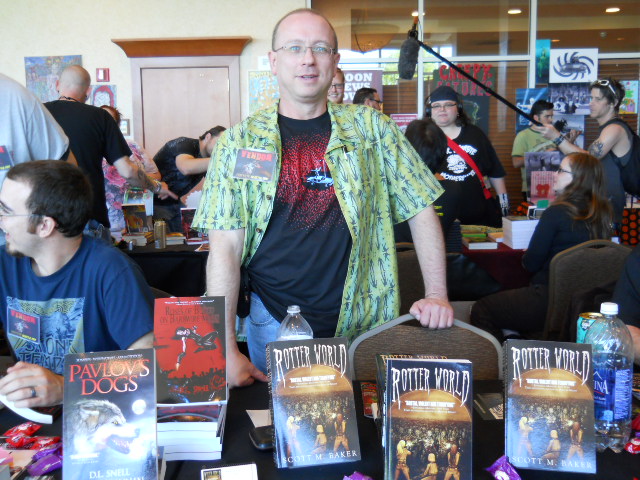
By the far the best part of the entire convention was sitting at the Permuted Press table. It's a great publishing house, and I'm excited to be a part of the Permuted family. Thanks to Jacob Kier, the publisher, for inviting me. Many thanks to the other Permuted authors who made me feel so welcome: D.L. Snell, Tony Favile, Craig DiLouie, Timothy W. Long, Gareth Wood, Peter Clines, Eloise J. Knapp, and Jessica Miegs. And many thanks to Tony for introducing me to "sweetened Coke."
I came home exhausted (my flight back into Washington landed at 4:40 AM), but had an epic time and am looking forward to attending in 2013. The next stop for me on the convention circuit is Infect Scranton 21-23 September where several Permuted Press authors will also have a table. Hope to see you there.
 It has taken me almost a week to get caught up, so I wanted to take a
few minutes to post about last weekend's Crypticon convention in
Seattle.
It has taken me almost a week to get caught up, so I wanted to take a
few minutes to post about last weekend's Crypticon convention in
Seattle. It was a tedious trip out to the west coast. I left Washington D.C. at 7:00 AM, flew five hours out to Long Beach where I then suffered through a five-hour layover (and for anyone who has ever been through Long Beach Airport, you know how little there is to do there), and then completed the final two-hour jaunt up to Seattle. I checked into my hotel after nearly fifteen hours on the road, arriving about an hour before my first panel session. But the seemingly endless trip was definitely worth it.
I sat on the usual zombie panels. "Are You Ready for the Zombie Apocalypse? Do You Plan To Survive?" is always fun because I love to compare bug out versus hunker down strategies, and I always pick up some good survivalist tips. (And thanks to Tony Favile for all his great advice.) "Zombies: Why the Fuck Won't They Die?" took a good-natured look at why the living dead not only have remained so popular in our culture but have not witnessed several break away subgenres as vampire fiction has. And there were numerous groans of protest when I mentioned the concept of sparkling zombies. (I promise that is not the plot of my next novel.) And it was an honor and a thrill to join my fellow authors at the Permuted Press Q&A session on Friday night and the joint reading on Sunday.
 |
| Me and Ricou Browning |
By the far the best part of the entire convention was sitting at the Permuted Press table. It's a great publishing house, and I'm excited to be a part of the Permuted family. Thanks to Jacob Kier, the publisher, for inviting me. Many thanks to the other Permuted authors who made me feel so welcome: D.L. Snell, Tony Favile, Craig DiLouie, Timothy W. Long, Gareth Wood, Peter Clines, Eloise J. Knapp, and Jessica Miegs. And many thanks to Tony for introducing me to "sweetened Coke."
I came home exhausted (my flight back into Washington landed at 4:40 AM), but had an epic time and am looking forward to attending in 2013. The next stop for me on the convention circuit is Infect Scranton 21-23 September where several Permuted Press authors will also have a table. Hope to see you there.
 |
| The Permuted gang at Crypticon. From left to right: D.L. Snell, Tony Faville, me, Craig DiLouie, Timothy Long, Gareth Wood, Peter Clines, Eloise J. Knapps (holding the assault rifle), Jacob Kier, and Jessica Miegs. |
Friday, June 1, 2012
SEX AND THE SINGLE ZOMBIE by Lane Adamson
Ha. Made you look.
Zombies--dead that rise and feast upon the flesh of the living, ghouls, to be more technically accurate--are all the, um, rage (as it were) nowadays. From the recordbreaking ratings of The Walking Dead on AMC to the bestselling (and soon-to-be Brad Pitt cinema vehicle) World War Z by Max Brooks, way back to the effective progenitor of this "generation" of the genre, George A Romero's Night of the Living Dead (and its sequels, and the remakes of each)--what is it about these grisly creatures and their ghastly antics that so captures the imaginations of so many?
As I see the zombie story (we'll stick with the Z-word because that's the familiar term, right or wrong), it's all about nihilism. Which is a 50-cent word that bears definition (credit American Heritage Dictionary):
nihilism [( neye -uh-liz-uhm, nee -uh-liz-uhm)]
An approach to philosophy that holds that human life is meaningless and that all religions, laws, moral codes, and political systems are thoroughly empty and false. The term is from the Latin nihil, meaning “nothing.”
In a nutshell, that pretty well explains the ending of Night of the Living Dead. (If you haven't seen it, I won't spoil it. But go see it. Right now. I'll wait for you to come back. All done? Good.) I've embraced this... ethos, for want of a better word, wholeheartedly in my own zombie writing; first and foremost in my approach to the subject is that there are no happy endings, ever.
How can there be? Think about it. The world as we know it has been decimated (or worse) by whatever apocalyptic scenario it is that has brought corpses, I SAID DEAD FREAKING CORPSES, JESUS H TAPDANCING CHRIST DID YOU HEAR ME, shambling to life and eating the faces off your friends, neighbors, and family.
Many of these godawful undead face-eaters are, in fact, your friends, neighbors, and family. And the only way to keep them from eating your face is to shoot them in the head, or whack them in the noggin with a machete, or otherwise do something nasty, gory, and devastating to what passes for a brain in what's left of their mouldering zombie skull.
Face it. There's just no way this ends well. The best one could hope for is to die peacefully in your sleep and then have your house burn down with you in it, before your remains rise to become one of the face-eaters. How in the name of Harold Robbins did this sort of thing become the stuff of best sellers and big box office, anyway?
That's a darned good question, little one. Why don't you go and ask your Mother?
Zombies--dead that rise and feast upon the flesh of the living, ghouls, to be more technically accurate--are all the, um, rage (as it were) nowadays. From the recordbreaking ratings of The Walking Dead on AMC to the bestselling (and soon-to-be Brad Pitt cinema vehicle) World War Z by Max Brooks, way back to the effective progenitor of this "generation" of the genre, George A Romero's Night of the Living Dead (and its sequels, and the remakes of each)--what is it about these grisly creatures and their ghastly antics that so captures the imaginations of so many?
As I see the zombie story (we'll stick with the Z-word because that's the familiar term, right or wrong), it's all about nihilism. Which is a 50-cent word that bears definition (credit American Heritage Dictionary):
nihilism [( neye -uh-liz-uhm, nee -uh-liz-uhm)]
An approach to philosophy that holds that human life is meaningless and that all religions, laws, moral codes, and political systems are thoroughly empty and false. The term is from the Latin nihil, meaning “nothing.”
In a nutshell, that pretty well explains the ending of Night of the Living Dead. (If you haven't seen it, I won't spoil it. But go see it. Right now. I'll wait for you to come back. All done? Good.) I've embraced this... ethos, for want of a better word, wholeheartedly in my own zombie writing; first and foremost in my approach to the subject is that there are no happy endings, ever.
How can there be? Think about it. The world as we know it has been decimated (or worse) by whatever apocalyptic scenario it is that has brought corpses, I SAID DEAD FREAKING CORPSES, JESUS H TAPDANCING CHRIST DID YOU HEAR ME, shambling to life and eating the faces off your friends, neighbors, and family.
Many of these godawful undead face-eaters are, in fact, your friends, neighbors, and family. And the only way to keep them from eating your face is to shoot them in the head, or whack them in the noggin with a machete, or otherwise do something nasty, gory, and devastating to what passes for a brain in what's left of their mouldering zombie skull.
Face it. There's just no way this ends well. The best one could hope for is to die peacefully in your sleep and then have your house burn down with you in it, before your remains rise to become one of the face-eaters. How in the name of Harold Robbins did this sort of thing become the stuff of best sellers and big box office, anyway?
That's a darned good question, little one. Why don't you go and ask your Mother?
Thursday, May 31, 2012
Chasing the Bear: A Cautionary Tale
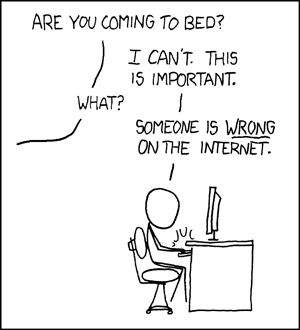
The Internet is a wonderful thing. It brings people together, it makes research easier, and it facilitates communication over a wide range of circumstances. It is also a digital distraction machine, and a marvelous time vacuum.
It is also (also) a wonderful way to shoot yourself in the foot, and then stick that same foot in your mouth.
(Picture it... you’re welcome.)
Participation in online discussion is fun and distracting, and sometimes it’s a great way to (ugh) “network” or otherwise show your professional contacts that, yes, you are a real flesh-and-blood person with feelings and beliefs and quirks. Unfortunately, this same venue is a way to show your professional contacts that, yes, from time to time you get a bug up your ass about something, and no amount of logical discourse will sway you from your opinion.
Oh, how fun!
Recently, I was embroiled in a discussion on a professional writers' forum, and I said some things probably that sounded like the beginnings of a "flame," or something. Then I got an email from someone who had been there longer than I that cautioned restraint on my part. I'm still debating whether I can do that.
 |
| Courtesy (and copyright) XKCD. |
So, here it is. The best thing about this situation, is that it isn’t in person, and the things that come out of you mouth (invective, coarse language, stuttering, etc.) are only heard by you until you expend the time and effort to type it all out and hit the SEND or POST button. And for every very public meltdown, there was a moment in time where the entire blow-up could have had the air let out of it by just... not... posting.
But it's hard not to. Neuroscience tells us the brain is ten parts emotion to one part reason. Our brain is, to quote a smart and funny man, "like a grizzly bear with a midget on the back, trying to control it*."
You can control it. I have faith in this, and I believe in you. Use the force, use Zen breathing techniques, use one of those squishy stress-relief balls, use the OFF switch. Something. You can do it.
And if you can do it, I can do it, too. We can live in Internet harmony.
Next week, I want to talk about how Alice Cooper is everything that's right about rock and roll.
-Thom Brannan
* - What's that? This blog is a partially-visual medium, and we don't need mental pictures? You're right!
 |
| Enjoy! Dr. McNinja courtesy and copyright, Chris Hastings Used with permission. See The Adventures of Dr. McNinja HERE. |
Tuesday, May 29, 2012
Meeting a Monster Legend by Scott M. Baker

This past weekend at Crypticon I spent most of my time glued to the Permuted Press table pimping Rotter World and getting to know my fellow authors. Don't get me wrong. I had a great time and am not complaining. But on Sunday morning I took a few minutes to sneak away and say hello to Ricou Browning (pictured above).
All you Monster Kids and Sci-Fi afficionados know that name without having to look at the poster behind us. Ricou Browning played the Gill Man in the water sequences in the 1954 classic Creature from the Black Lagoon and its two sequels, Revenge of the Creature (1955) and The Creature Walks Among Us (1956). [NOTE: Ben Chapman played the part of the Gill Man for all the scenes shot on land.] A whole generation sat on the edge of our seats while the Gill Man would swim underneath some buxomy blonde in a bathing suit (Julie Adams in Creature and Lori Nelson in Revenge), enthralled by her beauty, and all the while accompanied by Henry Mancini's unforgettable theme (da da daaaaaahhh, da da daaaaaahhh). We all knew this aquatic version of beauty and the beast would not end well, but we couldn't turn away.
Meeting Mr. Browning was an honor and a thrill for me, and not just because the Creature from the Black Lagoon and Revenge of the Creature were among my favorite movies growing up. He literally represents the last vestige of a rapidly fading era. Mr. Browning is the sole surviving actor to play one of Universal's iconic monsters.
All the others who portrayed those classic monsters (Frankenstein, Dracula, the Wolfman, the Mummy, the Invisible Man) are no longer with us. Boris Karloff, Bela Lugosi, Lon Cheney Jr., John Carradine, Glenn Strange, Claude Rains. These names are as familiar to us Monster Kids as are those of our relatives. In many cases, they passed away before we even became enthralled by the monstrous characters they played. Most of us only got to know them through late night television.
The Gill Man was different from the other Universal monsters. There was no supernatural element about him. No essence of evil. No innate warning about the hideous results of dabbling in things we have no business with. The Gill Man was much more sympathetic. In a way, he wasn't even a monster. He was an ecological anomaly, a throwback from a prehistoric era that survived into modern times only ti be killed by man. When man invaded his habitat, the Gill Man defended himself and was killed. When man took him from his habitat to put him on display in a Florida aquarium like a goldfish in a bowl, he escaped and was killed. When man experimented on him and changed him into an air-breathing creature, he let instinct prevail and returned to the sea where he finally met a dignified end. (The Gill Man was also the only Universal monster whose film career ended without first having to match wits with Abbott and Costello.)
I introduced myself to Mr. Browning before the convention opened. He was a charming gentleman. We chatted for a few minutes, mostly with me rambling on about how it was a pleasure to meet him and how much I loved the Creature movies. He thanked me, autographed a photo of himself in the Gill Man outfit while holding the head piece, posed for a few pictures, and then I headed back to my table. And for me it was a thrill. I had met a part of the history that had helped shape my childhood and led me into horror writing.
Friday, May 25, 2012
WHAT'S SO GREAT ABOUT THE APOCALYPSE, ANYWAY? by Lane Adamson
So, I'm sitting here looking at our little cul-de-sac of bloggers, our bloggerhood, if you will, and it occurs to me to wonder why it is that there's so all-fired much interest in writing about (not to mention reading about) the assorted post-apocalyptic scenarios in play nowadays.
I shall ponder upon that a spell.
Let's start small, with the writer's mind. (I can say that about writers; I'm one of them.) There are a couple of different tacks in play here. One is the J-trap theory, to borrow from Stephen King (might as well steal from the best, as they say). Each author's mind has a creative bend in it that catches ideas of assorted sizes. Ours happens to latch onto notions of a post-apocalyptic nature, instead of police procedurals or westerns. As for the other thing... I'll get back to that in a few.
For now, let's look at it from the reader's point of view. Like your summer blockbuster movies, post-apocalyptic stories tend to be big, loud, and in-your-face immediate. (There's a reason they call that thing where civilizations and the world go all gollywonkers an apocalypse, after all.) The tale itself can be personal and intimate (I'll reference I Am Legend here, the Matheson novel since adapted to film several times) or wide-open and sprawling (King's The Stand comes to mind, although in many ways the individual character portraits in that are also deeply intimate).
In any event, the storyteller takes the world the audience knows, and blows it up--often quite literally; the first novel of the genre I personally recall reading is Miller's scathing A Canticle for Leibowitz, about rebuilding after nuclear armageddon. (The beautifully bleak film On the Beach, also from this era, is likewise not to be missed.) Lately, of course, we like our apocalypses flavored with at least a soupçon of zombies of one sort or another.
(Ah, zombies. Des morts vivants. Our shambling, flesh-eating friends deserve a column all their own, in the not-too-distant future...)
All this death, destruction, and rebirth is a sort of virtual catharsis for the audience. Yeah, the factory closed and I got laid off and the rent is late and the daggum politicians are a yammering knot of worthless cobblerheads, but you know what? In this book, the world got blowed to hell and gone, but a simple, hard-working, straight-shooting fella like me survived and thrived by being simple and hard working. And shooting straight.
May not exactly give a body hope, but at least it takes your mind off your troubles a mite.
And then there's that other thing about writers: Hey, we like blowing stuff up, even in print. (In point of fact, it's quite a lot harder to write a good explosion than it is to just make one. Ask any chemist.) When we tear down the world for that post-apocalyptic scenario you'll be reading about, we get to decide what bits get to stay in for you, and what goes, and what gets tinkered with unmercifully.
That's the fun part of being a writer. Well, that and when you, the reader, tell us we've done a good job. That makes the whole apocalypse worthwhile.
Suggested reading (assorted apocalypses in chronological order):
I shall ponder upon that a spell.
Let's start small, with the writer's mind. (I can say that about writers; I'm one of them.) There are a couple of different tacks in play here. One is the J-trap theory, to borrow from Stephen King (might as well steal from the best, as they say). Each author's mind has a creative bend in it that catches ideas of assorted sizes. Ours happens to latch onto notions of a post-apocalyptic nature, instead of police procedurals or westerns. As for the other thing... I'll get back to that in a few.
For now, let's look at it from the reader's point of view. Like your summer blockbuster movies, post-apocalyptic stories tend to be big, loud, and in-your-face immediate. (There's a reason they call that thing where civilizations and the world go all gollywonkers an apocalypse, after all.) The tale itself can be personal and intimate (I'll reference I Am Legend here, the Matheson novel since adapted to film several times) or wide-open and sprawling (King's The Stand comes to mind, although in many ways the individual character portraits in that are also deeply intimate).
In any event, the storyteller takes the world the audience knows, and blows it up--often quite literally; the first novel of the genre I personally recall reading is Miller's scathing A Canticle for Leibowitz, about rebuilding after nuclear armageddon. (The beautifully bleak film On the Beach, also from this era, is likewise not to be missed.) Lately, of course, we like our apocalypses flavored with at least a soupçon of zombies of one sort or another.
(Ah, zombies. Des morts vivants. Our shambling, flesh-eating friends deserve a column all their own, in the not-too-distant future...)
All this death, destruction, and rebirth is a sort of virtual catharsis for the audience. Yeah, the factory closed and I got laid off and the rent is late and the daggum politicians are a yammering knot of worthless cobblerheads, but you know what? In this book, the world got blowed to hell and gone, but a simple, hard-working, straight-shooting fella like me survived and thrived by being simple and hard working. And shooting straight.
May not exactly give a body hope, but at least it takes your mind off your troubles a mite.
And then there's that other thing about writers: Hey, we like blowing stuff up, even in print. (In point of fact, it's quite a lot harder to write a good explosion than it is to just make one. Ask any chemist.) When we tear down the world for that post-apocalyptic scenario you'll be reading about, we get to decide what bits get to stay in for you, and what goes, and what gets tinkered with unmercifully.
That's the fun part of being a writer. Well, that and when you, the reader, tell us we've done a good job. That makes the whole apocalypse worthwhile.
***
Suggested reading (assorted apocalypses in chronological order):
- Day of the Triffids, John Wyndham (1951)
- I Am Legend, William Matheson (1954)
- A Canticle for Leibowitz, Walter M Miller, Jr (1960)
- Lucifer's Hammer, Jerry Pournelle & Larry Niven (1977)
- The Stand, Stephen King (1978)
- The Road, Cormac McCarthy (2006)
- And, of course, the complete PERMUTED PRESS catalogue
Thursday, May 24, 2012
He Hunts the Biggest of All Game
I’m in man-love with the Green Hornet.
The Green Hornet, if you didn’t know, is Britt Reid, a rich newspaperman that has had it up to here with corruption and crime in his city. Aided by his mechanical genius/sidekick Kato, he takes on the persona of the Green Hornet, a maverick operative in the Underworld, dedicated to bringing it down from within.
 |
| ...and lookin' smooth while doing it. |
Wacky, right? I love it. I always have. When I was a wee lad, I caught an episode of the 1960s Greenway production, the same company that brought Batman to the television screen. I was dumbfounded. I was appalled. I was amazed. I asked my dad who that was, and he just smiled. I mean, this guy had to be the real McCoy, right? He had freakin’ Bruce Lee as his sidekick!
Fast forward about ten years, and NOW! Comics had started their own line of Green Hornet comics, and I devoured them whenever I could... which wasn’t very often at all, unfortunately. In my most important formative years, I lived way deep in south Texas, in a little town (?) called Falcon Heights. The nearest place to buy comic books was in the mall in McAllen, Texas, a drive of seventy miles. And since I had no license, no car and no money, well... it might as well have been a mall on the moon.
Even later, once I had joined the Navy and had a pocket full of jingle-jangle, I didn’t have a lot of time to read comics, but I went to the shops anyway, just to see if they carried back issues of all the stuff I’d missed. More often than not, they didn’t.
It was as if the universe at large was against me, determined to stand between me and the Green Hornet. And much like everything else from that time in my life, it got put aside as my career as a submariner got underway. (See what I did there?)
In 2001, I got a desk job at a training office in Pearl Harbor, Hawai’i, and most of what I did was... bowling. Seriously. I was supposed to be coordinating an apprentice program thing, but since the civilian side of the shipyard was heavily unionized, over half of the things the participants of the program had to do to complete it wasn’t allowed because it was someone else’s specialty. So I bowled a lot.
I also discovered eBay.
 |
| ...not unlike this guy. |
All of a sudden, I could find (and afford) all those things I had to put down earlier, like finding every Destroyer novel, or whatever Grendel merchandise I could... or the Green Hornet comic books. Yesss. So I bought them all up and devoured every last four-color panel. (Or whatever they’re in. Shaddap.) And for a while, I was happy.
Holy crap, ten years went by. 2010 was a good year for the Hornet. There was a new series of comics from Dynamite! as well as a movie in the works. In the intervening decade, I had *ahem* picked up copies of the television show’s entire run, as well as the two movie serials from Universal and all the radio shows I could lay my grubby mitts on.
And then... and then it came home to me. I got an email from my good friend, Matthew Baugh, with whom I share space on four tables of contents, at last count. An outfit he was on good terms with, Moonstone Books, was putting together a prose anthology of Green Hornet stories, and he said he would put in a good word for me. As it was invitation-only, I didn’t get my hopes up, and I think Matthew had mentioned me in an editorial manner, as perhaps someone that would do very fast and well-done line edits.
Imagine my shock and surprise when I get an email that says Moonstone got too many people and they’re putting out another volume, so get your pen ready! Cue dancing for joy.
(I’m not talking about writing or the process, so I’ll skip ahead here.)
At this point, I should thank Joe Gentile, Matthew, CJ Henderson, and the several other authors that signed the hardcover copy I shipped around the country. It made my father proud.
And then the movie... I’ve already gone on record as saying that adaptations are always a mixed bag, and one should realize that the book is the book and the movie is the movie, and should never the twain meet, it should be no surprise and get over it, already. So that’s what I did. I put aside my reservations and watched Seth Rogan’s version of The Green Hornet, enjoying it for what it was. For the record, Kato was completely bad-ass.
 |
| Woohoo! This is the first volume. |
This year, Moonstone is putting out a third volume, The Green Hornet: Still at Large, of which I am pleased to say I am a part.
My wife, Kitty, understands my incredible fandom, and for one of those holidays where you get gifts, she gave me a replica of the Black Beauty to put on the shelf alongside the other cars of legend, the Batmobile, Ecto-1, and KITT.
I guess I said all that to say this: the Green Hornet, to me, will always represent the best of a hero. The character is brave, uncompromising and full of conviction. He commands loyalty of those around him and earns it. He’s got the right amount of gadgets to get the job done, but not so many that they’re plot devices. (I’m looking at you, Knight Rider.) And he gets the job done, by cunning and wits or two-fisted action (four-fisted, if you count Kato, which you should). If I had to pick a hero to emulate, it would be the Green Hornet. He’s the best of them.
Next week, I want to talk about the grizzly bear, and how you shouldn't let it get away from you.
-Thom Brannan
Wednesday, May 23, 2012
David Moody Reviews THE KILLING FLOOR by Craig DiLouie

This is great praise from one of the genre’s most successful and respect authors. Thank you, David!
Click here to learn more about THE KILLING FLOOR and other apocalyptic works by Craig DiLouie.
Tuesday, May 22, 2012
Letting a Monster Kid's Creativity Soar by Scott M. Baker
Anyone who has followed my blog knows I'm a bona fide Monster Kid. I had all the Aurora monster models, dozens of 8mm versions of classic horror and sci-fi movies from Castle Films, and a huge collection of Famous Monsters of Filmland (and believe me, I've been kicking myself for years for just throwing out those back issues when I started high school). Every Saturday afternoon, if I wasn't home watching my favorite monster movies on WLVI Channel 56's Creature Double Feature, I was hanging out with Curtis Brown and John Harrington at the Park Theater in downtown Everett where we watched those same creatures battle it out on the big screen. Those days bring back some epic memories.
Through it all, I was lucky to have parents who encouraged this monster mania, especially my mother. It's safe to say that if it wasn't for them, I probably wouldn't be posting this as a horror writer.
Recently a fan asked me a question about those years that for the life of me I couldn't answer: why did my mother allow me to be a Monster Kid rather than try and steer my energies into more traditional hobbies?
So this weekend I went on a quest to answer this question about my past. Well, not actually a quest. I hit the MUTE button on the remote and called my mother on the cell phone.
Me: "Mom, you gotta help me. I'm desperate for a blog and need to interview you."
Mom: [Laughing] "So I'm a last resort? That makes me feel good."
Me: "I was just curious why you indulged my love of monsters when I was a kid."
Mom: "Because you liked monsters, and I always let you do the things you liked."
Me: "Weren't you afraid I'd become a weird, twisted kid?"
Mom: "Of course not. I used to tell you those things weren't real. And you didn't turn out too bad."
The truth is I haven't done too bad turning my love for the macabre into a side career. And there were no adverse side effects. I didn't grow up to torture small animals (I'm an animal lover and dote on my four house rabbits) or torment other kids. I haven't secretly buried any bodies in the back woods of northern Virginia, and don't suffer from any more psychoses than most other writers.
However, the relevant part of this blog is not about me being a Monster Kid, but about my parents allowing me to pursue my passion. It would have been so easy for them to steer me into activities that were more in line with the other kids. Think about it. How many fathers imagine their sons winning the Superbowl or the World Series? Quite a few. How many imagine their sons getting a five-star review from Fangoria? Probably not that many. Yet my parents were wise enough to look beyond what I was passionate about to see that allowing me to express myself and be creative were what was best in the long run.
[NOTE: The only time they disagreed over my idiosyncracies was when I was ten and asked for a Barbie doll. My father was understandably aghast at the apparent gender crisis, but my mother was supportive. She asked, "And why do you want a Barbie?" I replied, "Because G.I. Joe needs shore leave." My father was relieved. My mother never did get me the doll.]
I love seeing that same creativity in kids today. My six-year-old niece Kiera and my girlfriend's ten-year-old daughter Maddy love to tell me stories, and I'm fascinated by each one they tell. Not because the stories are brilliant, but because of the passion with which they tell it, and the joy in their eyes because an adult is interested in what they have to say. I can't help but wonder (and hope) that some day these little girls will grow up to be another Anne Rice or J.K Rowling.
So let your kids express themselves and don't force them to conform. Their imaginations are much too precious to squander on reality.
Through it all, I was lucky to have parents who encouraged this monster mania, especially my mother. It's safe to say that if it wasn't for them, I probably wouldn't be posting this as a horror writer.
Recently a fan asked me a question about those years that for the life of me I couldn't answer: why did my mother allow me to be a Monster Kid rather than try and steer my energies into more traditional hobbies?
So this weekend I went on a quest to answer this question about my past. Well, not actually a quest. I hit the MUTE button on the remote and called my mother on the cell phone.
Me: "Mom, you gotta help me. I'm desperate for a blog and need to interview you."
Mom: [Laughing] "So I'm a last resort? That makes me feel good."
Me: "I was just curious why you indulged my love of monsters when I was a kid."
Mom: "Because you liked monsters, and I always let you do the things you liked."
Me: "Weren't you afraid I'd become a weird, twisted kid?"
Mom: "Of course not. I used to tell you those things weren't real. And you didn't turn out too bad."
The truth is I haven't done too bad turning my love for the macabre into a side career. And there were no adverse side effects. I didn't grow up to torture small animals (I'm an animal lover and dote on my four house rabbits) or torment other kids. I haven't secretly buried any bodies in the back woods of northern Virginia, and don't suffer from any more psychoses than most other writers.
However, the relevant part of this blog is not about me being a Monster Kid, but about my parents allowing me to pursue my passion. It would have been so easy for them to steer me into activities that were more in line with the other kids. Think about it. How many fathers imagine their sons winning the Superbowl or the World Series? Quite a few. How many imagine their sons getting a five-star review from Fangoria? Probably not that many. Yet my parents were wise enough to look beyond what I was passionate about to see that allowing me to express myself and be creative were what was best in the long run.
[NOTE: The only time they disagreed over my idiosyncracies was when I was ten and asked for a Barbie doll. My father was understandably aghast at the apparent gender crisis, but my mother was supportive. She asked, "And why do you want a Barbie?" I replied, "Because G.I. Joe needs shore leave." My father was relieved. My mother never did get me the doll.]
I love seeing that same creativity in kids today. My six-year-old niece Kiera and my girlfriend's ten-year-old daughter Maddy love to tell me stories, and I'm fascinated by each one they tell. Not because the stories are brilliant, but because of the passion with which they tell it, and the joy in their eyes because an adult is interested in what they have to say. I can't help but wonder (and hope) that some day these little girls will grow up to be another Anne Rice or J.K Rowling.
So let your kids express themselves and don't force them to conform. Their imaginations are much too precious to squander on reality.
Monday, May 21, 2012
"Judgment Day in a Dark World: Searching for the Self through Family and Horror" by Patrick Williams
I had a
conversation with a student this semester; he is a musician and we were
discussing dark narratives and how people perceive the creators of said
narratives. For example, how does our reading Stephen King’s texts influence
the way we perceive him as a person? In the simplest terms, how many readers
think, “This guy has to be a sick fuck to come up with these plots”?
And this
discussion got me thinking. . .
Dead Meat was recently published by
Permuted Press. In the book, there’s plenty of gore, cursing, and just a flat
out brutal exploration of the human psyche and its complexities and
inconsistencies. And I wonder, how will my kids view me when they read this
book and the others I hope to publish?
My nine year
old stepson periodically looks at the cover of Dead Meat, and I can’t help but wonder what goes through his innocent
brain. The only thing he knows is that the book is about zombies. He doesn’t
understand the depth of the story or the darkness of human nature explored in
the book. I’m waiting for the day where I walk into my office and see him
lounging in the recliner with Dead Meat
open in his lap. Will he cringe at the gore? The cussing? The, as King puts it,
“dark fuckery of the human heart”?
And that’s
not all. On top of my stepson, my wife broke the news to me, stating, “I just
don’t see you as a horror writer.” And she’s right; since we started dating
years ago, she’s always known my poetry and my desire to write fantasy. I don’t
think I really see myself as a horror writer necessarily, but the gore, the
characters, and the plots can be so enticing at times.
Finally, all
of the previous episodes were capped by my brother and co-author of Dead Meat, Chris. We’ve been working on
a series of novellas, and he’s got a great idea of one that involves pre-teen
children. The story will take place in the Dead
Meat world, and the thought of hurting these characters that have yet to be
written made me cringe. I didn’t know if I could write it, and I’m still not
sure.
But I will.
I must. This is just another hurdle for writers, another sacrifice made for the
sake of the art of storytelling.
There will
always be someone who doesn’t care for the genre, and there will always be
people who will judge the morals, ethics, and values of authors who write
brutal fiction. But in the end, fuck those people; they aren’t the ones who
matter. Those who matter are the readers, the fans of the genre, and then those
young children, my children, who run to me when they’re scared, when the house
is too dark, or when they hear the noises outside.
Will they
still run to me when they know I’m capable of scaring them just as much as the
world outside? Will they look at Dad differently, knowing that he purposely
murders people (in stories), telling their agonizing deaths in great lengths to
appease the readers’ hunger? Will my kids think of them as “just stories”?
This reminds
me of a Sylvia Plath poem titled “Child”:
Your clear
eye is the one absolutely beautiful thing.
I want to
fill it with color and ducks,
The zoo of
the new
Whose name
you meditate --
April
snowdrop, Indian pipe,
Little
Stalk
without wrinkle,
Pool in
which images
Should be
grand and classical
Not this
troublous
Wringing of
hands, this dark
Ceiling
without a star.
A zombie
book is as potent as Plath’s closing images, but the fact that there’s a
darkness within me, or at least a perceived darkness, remains. And while I want
to show my children the ducks and everything else beautiful about our world, I
know that regardless of the situation, they’ll eventually see my “troublous /
Wringing of hands” and “this dark / Ceiling,” whether I want them to or not. I
can’t protect them from how they’ll eventually see their father/stepfather when
it comes to the book and how they interpret it. I can only hope that my role as
a loving parental figure will outweigh the perceived darkness residing in me.
In the end,
we all make sacrifices. But hopefully, those sacrifices are based on educated
and informed decisions. In this case, a case many authors face, we sacrifice
ourselves for the sake of telling a story. We willingly take on this dark
persona, even if it’s initially nonexistent, to fuel our passions, our desires
to create compelling stories.
So when my
children grow and eventually read the book, they’ll pose the difficult
question: “What made you think of this, Dad?”
The love of
the art, I’ll answer. And that’s the best, most meaningful answer I can give,
the only answer that can make a moral out of this story:
Follow your
dreams, even if they take down a rabbit hole, through a social and cultural
collapse, and into a post-apocalyptic zombie infested world.
Subscribe to:
Posts (Atom)