“Great. I have my query drafted and ready to send out. Where do I find publishers and literary agents to submit it to?”
Here is where I date myself. When I first became interested in writing years ago, the Bible of the publishing industry was The Writer’s Market. Without the latest edition on your desk, your chances of getting published were slim. However, relying on The Writer’s Market
today is about as antiquated as drafting your manuscript on an electric
typewriter. The publishing industry now has an increasing number of
small presses and a rapidly expanding market for presses who deal solely
or primarily in electronic media, and these publishers open (and
sometimes close) at a mind-boggling rate. The good news is that keeping
track of who’s who in the market has never been easier.
I
use five methods to keep track of the market. More are available, but
these are the ones I primarily rely on. Use whichever ones work for you
or your genre.
-- Internet-based publishers digests.
There are several out there that encompass all markets and genres, but
my favorite is Duotrope (http://www.duotrope.com/).
Duotrope allows you to narrowly define your search parameters to
provide listings based on genre, type of publication (book or magazine,
print or electronic), length of work, submission guidelines, and other
criteria. Each listing also contains a link to that publisher’s
homepage. One feature about this service I particularly like is that you
can sign up for Duotrope’s weekly e-mail update which lists markets
that are open to submission, updates those markets that are dead or
recently closed to submissions, and provides a list of upcoming
anthologies by theme. In my opinion, this is one of the best tools for
writers currently out there. Several of my works were eventually placed
with publishers I discovered on Duotrope.
-- Trade
journals and genre magazines. These are invaluable, especially the
former. I don’t know what’s available for other genres, but for horror I
rely on Realms of Fantasy as my trade journal and Fangoria and Rue Morgue
as my primary genre magazines. Their value is in that they provide
information on what is being published in your genre and who is
publishing it. I use Realms of Fantasy to keep track of trends in
the industry and use the book review sections of the genre magazines to
obtain leads on publishers who work in my genre.
--
Conventions. Though less readily available then the first two, writers
and genre conventions are among your most valuable resource. Publishers
use these conventions to seek out new talent, so they are most receptive
to hear what you have to offer. Practice your verbal pitch. You want to
have a pitch that hooks a publisher in the first few sentences, but
doesn’t sound over rehearsed. And be prepared in case the publisher
starts asking detailed questions about your work or you. I have seen a
lot of authors nail that opening pitch and get all tongue-tied during
the follow-up talks. Remember, nobody knows you and your book better
than you do. And if you find a publisher who wants to see more of your
work, contact him/her the moment you get home, reminding him/her in your
cover letter that you just met at the convention and you are sending
along the material he/she asked you to.
-- Your local
bookstore. You can find a wealth of information here by perusing your
genre section. Check out new arrivals to see which houses have published
books similar to yours, and use that as a starting point for your
research. Also remember to check out the acknowledgement page, for you
often get the names of editors to contact as well as literary agents.
--
Forums and Yahoo groups. These can be extremely helpful if you join the
correct ones. You want to find ones populated by aspiring and/or new
authors who are serious about their craft. Publishers and editors often
cruise these sites searching for new talent, and if they are impressed
with you they may contact you offline and ask you to submit. I have also
seen some forums/groups where publishers are actively seeking out
authors. You should be able to find these forums/groups by researching
in your genre. (These forums/groups are also invaluable in helping you
market your book, which I will discuss in the next blog posting.)
All
right, ladies and gentlemen. For those of you who have been reading
this blog series from the beginning, you have enough tools available to
write your novel. You’ve abandoned family and friends to make the time
to write and have spent the last year drafting and editing and revising
and re-editing and re-revising your book. You’ve sent out an endless
stream of query letters, suffered through the flood of rejections
letters (or worse, the annoying lack of responses from publishers you’ve
queried) but have prevailed and finally found someone to publish your
work. Congratulations! Now the hard part begins.
NEXT BLOG: Marketing your book and yourself.

Tuesday, August 28, 2012

Tuesday, August 21, 2012
Finding a Publisher or Literary Agent Part II by Scott M. Baker
Let me add a few observations to last week's blog about query
letters. These are my opinions, and should not be taken as gospel for
getting published (or as legal advice).
-- Publishers/agents are specific in what they want you submit along with your query, usually asking for sample chapters and a synopsis, and occasionally for a bio or a marketing strategy. Sometimes they ask for sample chapters to be submitted in a certain font or style. If you submit a query, be sure to provide what they ask for in the style they ask for. Although the main reason a publisher/agent asks for sample chapters and a synopsis is to get a feel for your writing style, your query submission also gives them a feel for how well you follow guidelines. If a publisher/agent asks for a three-page synopsis, one sample chapter in Courier 10 font, and a marketing strategy, and instead you send a one-page synopsis, three sample chapters in Times New Roman 12 font, and a bio, you immediately send the impression that you cannot/will not follow simple guidelines. Publishers/agents will be cautious about contracting with you, fearing that you may also be unwilling/unable to follow their editorial guidance and meet deadlines. [NOTE: While I’m willing to make certain changes to the text of sample chapters per the request of a publisher/agent – such as fonts, line spacing, or margins, all of which can easily be done on a computer – I refuse to entirely reformat my manuscript for a query. I did that once. A publisher's webpage said they were accepting manuscripts for consideration, so I spent two days preparing the submission to their meet their formatting guidelines, e-mailed the query, and got a response less than an hour later saying the publisher was no longer accepting submissions. Needless to say, I never made that mistake again.]
-- Every publisher and agent I have talked to has decried simultaneous submissions (sending query submissions to more than one publisher/agnet at a time), each of them relating how they spent several hours reading a submission, got excited about the work, and called back the author only to find that he/she had contracted with someone else. While I understand their rationale for refusing simultaneous submissions, I find it unreasonable. It can take months for a publisher/agent to respond to you, if they respond at all, and more often than not they are not interested in seeing the entire manuscript. That restriction against simultaneous places an unfair burden on aspiring authors. I see no problem with sending queries to more than one publisher at a time. However, and this is vital, show professional courtesy. If you have a manuscript with one publisher/agent and a second asks to see it, let the second publisher/agent know that someone else is currently looking at it. Publishers/agents will understand if they contact you based on a query, but someone else has contracted the manuscript before them. However, if they read the entire manuscript and then find out you were shopping that same manuscript to their competitors, you’ll earn a reputation you do not want to have in the industry.
-- Finally, do not feel compelled to accept any contract offered to you. I’ve been very fortunate that my publisher treats its authors fairly and with respect. Not all of them are like that. Last year I was contacted by a publisher who said how much he loved my manuscript and wanted to send me a contract. When I received it I laughed. The publisher wanted all rights (print, electronic, audio, radio, TV, movie, and character) to my first four books in perpetuity (i.e. forever) for a measly 10 percent royalty on any profits. The contract should have been emblazoned with a skull and crossbones in the corner. If the contract doesn’t settle right with you, trust your instincts and question it. Do not sign on the dotted line out of fear that no one will ever offer you another contract again. You worked too hard on that book to give away all the rights to someone else. Think of how badly George Lucas would have been screwed if he had given away to 20th Century Fox all the rights to Star Wars.
When it comes to discussing query submissions, this blog just touches the tip of the iceberg. But at least it gives you a framework to start from.
Below I included a sample query letter to use as a guideline.
Dear Publisher/Agent:
While researching potential publishers for my manuscript, I discovered your homepage and decided to contact you to gauge your interest in my book.
The Vampire Hunters are Drake Matthews and Alison Monroe, two former cops who turned in their badges for stakes, and Jim Delmarco, an engineering student with a knack for developing lethal weapons against the undead. Their target is a nest of more than a dozen vampires located in Washington D.C. and led by two masters, one of whom prefers to indulge his decadence rather than ensure the nest's survival, and his mistress who will go to any lengths to gain control over the nest. Driven by a determination to rid the city of this ultimate evil, and armed with nothing more sophisticated than low-tech conventional weapons, the hunters wage a relentless and violent war against the undead in the streets and back alleys of the nation's capital.
In The Vampire Hunters I flesh out the vampires so they are an integral part of the story but, unlike many contemporary novels, I depict my vampires as vicious and inhuman. With the recent success of such books as David Wellington's Bullet series and del Toro's/Hogan's Strain trilogy, The Vampire Hunters is perfectly poised to take advantage of the growing interest in vampires as evil, non-romantic characters.
The manuscript is 78,000 words in length and is ready for immediate submission.
As I noted above, the manuscript is the first in a trilogy. I have completed The Vampire Hunters: Vampyrnomicon (the introduction of the Master vampire, Chiang Shih, and her plan to establish a vampire kingdom), which is 100,000 words in length. The final book in the trilogy, The Vampire Hunters: Dominion (the final battle between good and evil), will be completed in the spring of 2010 and should be 100,000 words in length.
As for previous writing credits, I have authored several short stories, including “Rednecks Shouldn’t Play with Dead Things,” which appeared in the autumn 2008 edition of the e-zine Necrotic Tissue; “Cruise of the Living Dead,” which appeared in Living Dead Press’ Dead Worlds: Volume 3 anthology (August 2009); “Deck the Malls with Bowels of Holly,” which appeared in Living Dead Press‘ Christmas Is Dead anthology (October 2009); and “Denizens,” which appeared in Living Dead Press’ The Book of Horror anthology (March 2010).
Per your guidelines, I have included the first thirty pages and a synopsis so you can get a feel for my writing. I can forward the entire manuscript upon request.
Thank you for your time and consideration. I look forward to hearing from you.
Sincerely yours,
Scott M. Baker
phone number
website URL
blog URL
Facebook URL
Twitter URL
NEXT WEEK: Finding a Publisher or Literary Agent, Part III (where to find them).
-- Publishers/agents are specific in what they want you submit along with your query, usually asking for sample chapters and a synopsis, and occasionally for a bio or a marketing strategy. Sometimes they ask for sample chapters to be submitted in a certain font or style. If you submit a query, be sure to provide what they ask for in the style they ask for. Although the main reason a publisher/agent asks for sample chapters and a synopsis is to get a feel for your writing style, your query submission also gives them a feel for how well you follow guidelines. If a publisher/agent asks for a three-page synopsis, one sample chapter in Courier 10 font, and a marketing strategy, and instead you send a one-page synopsis, three sample chapters in Times New Roman 12 font, and a bio, you immediately send the impression that you cannot/will not follow simple guidelines. Publishers/agents will be cautious about contracting with you, fearing that you may also be unwilling/unable to follow their editorial guidance and meet deadlines. [NOTE: While I’m willing to make certain changes to the text of sample chapters per the request of a publisher/agent – such as fonts, line spacing, or margins, all of which can easily be done on a computer – I refuse to entirely reformat my manuscript for a query. I did that once. A publisher's webpage said they were accepting manuscripts for consideration, so I spent two days preparing the submission to their meet their formatting guidelines, e-mailed the query, and got a response less than an hour later saying the publisher was no longer accepting submissions. Needless to say, I never made that mistake again.]
-- Every publisher and agent I have talked to has decried simultaneous submissions (sending query submissions to more than one publisher/agnet at a time), each of them relating how they spent several hours reading a submission, got excited about the work, and called back the author only to find that he/she had contracted with someone else. While I understand their rationale for refusing simultaneous submissions, I find it unreasonable. It can take months for a publisher/agent to respond to you, if they respond at all, and more often than not they are not interested in seeing the entire manuscript. That restriction against simultaneous places an unfair burden on aspiring authors. I see no problem with sending queries to more than one publisher at a time. However, and this is vital, show professional courtesy. If you have a manuscript with one publisher/agent and a second asks to see it, let the second publisher/agent know that someone else is currently looking at it. Publishers/agents will understand if they contact you based on a query, but someone else has contracted the manuscript before them. However, if they read the entire manuscript and then find out you were shopping that same manuscript to their competitors, you’ll earn a reputation you do not want to have in the industry.
-- Finally, do not feel compelled to accept any contract offered to you. I’ve been very fortunate that my publisher treats its authors fairly and with respect. Not all of them are like that. Last year I was contacted by a publisher who said how much he loved my manuscript and wanted to send me a contract. When I received it I laughed. The publisher wanted all rights (print, electronic, audio, radio, TV, movie, and character) to my first four books in perpetuity (i.e. forever) for a measly 10 percent royalty on any profits. The contract should have been emblazoned with a skull and crossbones in the corner. If the contract doesn’t settle right with you, trust your instincts and question it. Do not sign on the dotted line out of fear that no one will ever offer you another contract again. You worked too hard on that book to give away all the rights to someone else. Think of how badly George Lucas would have been screwed if he had given away to 20th Century Fox all the rights to Star Wars.
When it comes to discussing query submissions, this blog just touches the tip of the iceberg. But at least it gives you a framework to start from.
Below I included a sample query letter to use as a guideline.
Dear Publisher/Agent:
While researching potential publishers for my manuscript, I discovered your homepage and decided to contact you to gauge your interest in my book.
The Vampire Hunters are Drake Matthews and Alison Monroe, two former cops who turned in their badges for stakes, and Jim Delmarco, an engineering student with a knack for developing lethal weapons against the undead. Their target is a nest of more than a dozen vampires located in Washington D.C. and led by two masters, one of whom prefers to indulge his decadence rather than ensure the nest's survival, and his mistress who will go to any lengths to gain control over the nest. Driven by a determination to rid the city of this ultimate evil, and armed with nothing more sophisticated than low-tech conventional weapons, the hunters wage a relentless and violent war against the undead in the streets and back alleys of the nation's capital.
In The Vampire Hunters I flesh out the vampires so they are an integral part of the story but, unlike many contemporary novels, I depict my vampires as vicious and inhuman. With the recent success of such books as David Wellington's Bullet series and del Toro's/Hogan's Strain trilogy, The Vampire Hunters is perfectly poised to take advantage of the growing interest in vampires as evil, non-romantic characters.
The manuscript is 78,000 words in length and is ready for immediate submission.
As I noted above, the manuscript is the first in a trilogy. I have completed The Vampire Hunters: Vampyrnomicon (the introduction of the Master vampire, Chiang Shih, and her plan to establish a vampire kingdom), which is 100,000 words in length. The final book in the trilogy, The Vampire Hunters: Dominion (the final battle between good and evil), will be completed in the spring of 2010 and should be 100,000 words in length.
As for previous writing credits, I have authored several short stories, including “Rednecks Shouldn’t Play with Dead Things,” which appeared in the autumn 2008 edition of the e-zine Necrotic Tissue; “Cruise of the Living Dead,” which appeared in Living Dead Press’ Dead Worlds: Volume 3 anthology (August 2009); “Deck the Malls with Bowels of Holly,” which appeared in Living Dead Press‘ Christmas Is Dead anthology (October 2009); and “Denizens,” which appeared in Living Dead Press’ The Book of Horror anthology (March 2010).
Per your guidelines, I have included the first thirty pages and a synopsis so you can get a feel for my writing. I can forward the entire manuscript upon request.
Thank you for your time and consideration. I look forward to hearing from you.
Sincerely yours,
Scott M. Baker
phone number
website URL
blog URL
Facebook URL
Twitter URL
NEXT WEEK: Finding a Publisher or Literary Agent, Part III (where to find them).
Tuesday, August 14, 2012
Finding a Publisher or Literary Agent Part I by Scott M. Baker
“How difficult is it to draft a query letter? And how do I find a publisher or agent to send it to?”
First hings first. It’s not that difficult to write a query letter. Which is fortunate, because drafting a good query letter is the most important aspect (next to actually writing the book) of getting published. You may have written the next bestseller, but if you can’t garner enough interest from publishers or literary agents to look at it, your novel/story is just taking up space on your hard drive.
Let me preface this section by stating that there are numerous ways to write a query. Use the format that best works for your work, or that you feel most comfortable with. What I’m offering are tips on how I draft a query, and so far they seem to have been successful for me. Also, this format should be used only for works of fiction. Non-fiction query guidelines are much different.
Start out with a brief introduction on how you discovered the publisher/agent. If a published author has referred you to them, or if you met this person at a convention and he/she asked you to forward a submission, state that up front. It gives you a foot up to climb out of the slush pile. Otherwise, just say that you discovered them while researching potential publishers/agents for your work, and you wanted to give them the opportunity to review your manuscript.
Next comes a brief description of your novel/story. Keep it to one small paragraph, two at most. Make it just long enough to provide a general idea what the work is about and entice the publisher/agent to want to read more. How do you do this? Read a few examples from jacket covers or the back of a paperback to get an idea. Remember, this is the make or break paragraph of the entire query. If you do not immediately snag the interest of a publisher/ agent, they’ll throw the query aside and move on to the next one. You need to get a hook into them so they’ll continue reading.
Your next paragraph has to sell the concept. The publisher/agent will receive hundreds of submission for romances, murder mysteries, vampire thrillers, animal books, or whatever genre you write in. Your novel/story must stand out. Saying your mother or spouse thought it was terrific will not get you published. Nor will telling them that you’re the next Stephen King or Dan Brown get you out of the slush pile. Publishing is a business, and your work will never make it into print unless you can convince the publisher/agent that it’s perfectly poised to take advantage of a new trend in the market, or brings specific insight to the genre that has not been seen before.
Follow with a brief paragraph noting what is attached to your e-mail, the word count, and whether the novel/story is available for immediate submission. [NOTE: Don’t waste your time querying publishers/agents with unfinished work. Rarely do they show interest in them.] If your novel is part of a series, now is the time to state that and, if known, offer an idea when the next book(s) in the series will be available.
Your penultimate paragraph should be about you. What makes you qualified to write this novel/story? Are you a police detective writing about a homicide unit in New York? Were you the victim of an abusive relationship, or a recovering addict, who has fictionalized your life? If you have no specific experiences you can relate to (I’ve never hunted vampires for a living, though I would like to), find a way to make yourself interesting. You’re selling yourself as well as your book.
This is also the paragraph to list your previous writing credits. Don’t list more than three otherwise you’ll look like you’re being pompous. List the most recent works, or those that are most relevant to your query. [NOTE: If you’re writing in a genre in which you don’t have relevant experience, I recommend trying to get several short stories published before you attempt to query on a book. Being able to say that you’ve been previously published bolsters your credentials. I noticed that publishers/agents showed more interest in looking at my novel after I had a few short stories in my bibliography.]
Finally, end with a closing sentence thanking them for their consideration and noting that you look forward to hearing from them.
NEXT: Finding a Publisher or Literary Agent, Part II (some useful tips on writing queries and a sample query letter)
First hings first. It’s not that difficult to write a query letter. Which is fortunate, because drafting a good query letter is the most important aspect (next to actually writing the book) of getting published. You may have written the next bestseller, but if you can’t garner enough interest from publishers or literary agents to look at it, your novel/story is just taking up space on your hard drive.
Let me preface this section by stating that there are numerous ways to write a query. Use the format that best works for your work, or that you feel most comfortable with. What I’m offering are tips on how I draft a query, and so far they seem to have been successful for me. Also, this format should be used only for works of fiction. Non-fiction query guidelines are much different.
Start out with a brief introduction on how you discovered the publisher/agent. If a published author has referred you to them, or if you met this person at a convention and he/she asked you to forward a submission, state that up front. It gives you a foot up to climb out of the slush pile. Otherwise, just say that you discovered them while researching potential publishers/agents for your work, and you wanted to give them the opportunity to review your manuscript.
Next comes a brief description of your novel/story. Keep it to one small paragraph, two at most. Make it just long enough to provide a general idea what the work is about and entice the publisher/agent to want to read more. How do you do this? Read a few examples from jacket covers or the back of a paperback to get an idea. Remember, this is the make or break paragraph of the entire query. If you do not immediately snag the interest of a publisher/ agent, they’ll throw the query aside and move on to the next one. You need to get a hook into them so they’ll continue reading.
Your next paragraph has to sell the concept. The publisher/agent will receive hundreds of submission for romances, murder mysteries, vampire thrillers, animal books, or whatever genre you write in. Your novel/story must stand out. Saying your mother or spouse thought it was terrific will not get you published. Nor will telling them that you’re the next Stephen King or Dan Brown get you out of the slush pile. Publishing is a business, and your work will never make it into print unless you can convince the publisher/agent that it’s perfectly poised to take advantage of a new trend in the market, or brings specific insight to the genre that has not been seen before.
Follow with a brief paragraph noting what is attached to your e-mail, the word count, and whether the novel/story is available for immediate submission. [NOTE: Don’t waste your time querying publishers/agents with unfinished work. Rarely do they show interest in them.] If your novel is part of a series, now is the time to state that and, if known, offer an idea when the next book(s) in the series will be available.
Your penultimate paragraph should be about you. What makes you qualified to write this novel/story? Are you a police detective writing about a homicide unit in New York? Were you the victim of an abusive relationship, or a recovering addict, who has fictionalized your life? If you have no specific experiences you can relate to (I’ve never hunted vampires for a living, though I would like to), find a way to make yourself interesting. You’re selling yourself as well as your book.
This is also the paragraph to list your previous writing credits. Don’t list more than three otherwise you’ll look like you’re being pompous. List the most recent works, or those that are most relevant to your query. [NOTE: If you’re writing in a genre in which you don’t have relevant experience, I recommend trying to get several short stories published before you attempt to query on a book. Being able to say that you’ve been previously published bolsters your credentials. I noticed that publishers/agents showed more interest in looking at my novel after I had a few short stories in my bibliography.]
Finally, end with a closing sentence thanking them for their consideration and noting that you look forward to hearing from them.
NEXT: Finding a Publisher or Literary Agent, Part II (some useful tips on writing queries and a sample query letter)
Tuesday, August 7, 2012
The Mechanics of Writing by Scott M. Baker
“I have a story idea in mind and am psyched to begin writing. What’s
the best way to get started? Should I outline the plot first, or just
jump in and write?”
There’s no right or wrong method to use in plotting out your novel. The mechanics of writing is one of personal choice, so go with whatever method works best for you.
For example, Jeffery Deaver creates meticulous outlines for his novels, detailing each scene and key segments of dialogue on sheets of paper and sticky notes that fill the walls of his study. He admits that it takes him months to come up with such a detailed framework. However, when he sits down to actually write the novel, since most of the work is already completed, it doesn’t take him long to finish the manuscript.
I prefer a less structured method. When I’m plotting out my novels, I keep a stack of lined 3x5 cards handy and write scenes down as I think of them. On each card I include anything that I want to put into the scene, such as descriptions, plot points, or snippets of dialogue I don’t want to forget. Before I start writing, I arrange the cards in the order I want the book to flow. This allows me to outline the major themes in the plot, but allows enough flexibility that I can add or re-order scenes easily.
These methods represent two different concepts of organization, and most of you will use a method of plot outlining that falls somewhere in between. What is important is, no matter which method you use, be sure you have a firm grasp of the opening, conflict, and resolution of your story before you begin outlining/writing your story. You can always change those elements later. But if you don’t have a basic idea where your story starts and ends, no amount of outlining will turn it into a viable manuscript. Trust me on this one. I have several short stories taking up space on my hard drive because I wrote them based on a single scene, but have yet to find an effective way to start or end them.
“Thanks. This has been a big help. While you’re here, can you give me any tips on writing?”
Yes, I can. But this is not the blog series for that. There are thousands of books out there dedicated to instructing someone on how to write a book. They cover all the aspects of writing – plot, setting, character development, voice, etc. There are even books that tell you how to write in specific genres. Feel free to use them if you want. No one has ever become a bad writer by reading these works.
In my opinion, the best way for someone to become a good writer is to read in order to see how other authors write, and then start writing yourself. When I say read a lot, I mean it. Go through at least one book a week. Start with the classics. We’re still reading Twain, Hemingway, Austen, and the like not just because our English professors are sadists, but because those authors knew how to write compelling stories that have stood the test of time. Then read a wide variety of books and authors in whatever genre you’re writing in, as well as at least a few books outside your genre.
And don’t forget to read trashy books, whether they’re pulp novels meant solely to entertain and entice, or novels that are just horribly written. Figure out what those authors did to make their works so laughable or painful to read, and learn from their mistakes. Remember, it takes a long time and many published works to build up a fan base, but only one poorly-written story or novel to turn off readers forever.
So while I won’t offer writing tips in this blog series, I do want to point out that there are certain aspects of writing you need to pay close attention to if you ever hope to get out of the slush pile and get published. These points have been reiterated to me time and again by publishers and literary agents, all of whom said that when they see these types of mistakes in query submissions, they immediately take the work out of contention for publication.
The first is grammar, punctuation, and spelling. Over time you’ll find your own writing style and voice. But if you don’t have the basics down, you’ll find it that much more difficult to break away from the thousands of other authors bombarding publishers and agents with their works. As part of this advice, make sure you proof read your final work carefully. You may have written the next bestseller, but if your sample chapters are chocked full of spelling mistakes, grammatical errors, and incorrect punctuation, good luck getting a publisher or agent to read beyond the first few pages. Even if they see the potential in your book, they’ll view you a sloppy author and will think carefully before taking you on. And if comes down between you and an author whose writing is solid, who do you think will get the contract?
Realistic dialogue is also very important to sealing that book deal. So of course, it’s one of the hardest parts to get right. If you write dialogue so that it’s grammatically correct, it sounds stilted and turns off the reader. If you write it to sound like every day conversations, you run the risk of making your characters sound like idiots. I trained myself to write decent dialogue by listening to others talk. This has the added benefit of letting people think you’re the silent, mysterious type (or they’ll just think you’re an introvert, which most writers are).
Finally, make sure you maintain the continuity of your story and characters. If your main character’s name is Ken Smith, always refer to him as either Ken or Smith throughout the story, and do not interchange the names. Keep your secondary characters straight as well; if you call someone Bob when he first appears in chapter three, make sure you don’t call him Bill when he reappears in chapter ten. If you describe your main character as being bald in chapter one, don’t have him run his fingers through his hair in chapter five. If your character is a devout Mormon, don’t show him/her drinking a cup of coffee without explaining why. If your story is set in Maine in the middle of December, don’t have the characters sunbathing three scenes later. If your story is set in Victorian-era New York, don’t have electric street lamps lining the streets. These are the minutiae that are easy to overlook. When publishers or agents catch them, they immediately get the impression that you’re a sloppy writer (see above). And if your readers catch them, you lose them quickly. I have had several authors who write historical dramas tell me that the worst criticism they receive from readers is when they get some historical fact wrong.
So consider yourself forewarned. Now get out there and start writing. Your public is waiting.
NEXT BLOG: Finding a publisher or literary agent.
There’s no right or wrong method to use in plotting out your novel. The mechanics of writing is one of personal choice, so go with whatever method works best for you.
For example, Jeffery Deaver creates meticulous outlines for his novels, detailing each scene and key segments of dialogue on sheets of paper and sticky notes that fill the walls of his study. He admits that it takes him months to come up with such a detailed framework. However, when he sits down to actually write the novel, since most of the work is already completed, it doesn’t take him long to finish the manuscript.
I prefer a less structured method. When I’m plotting out my novels, I keep a stack of lined 3x5 cards handy and write scenes down as I think of them. On each card I include anything that I want to put into the scene, such as descriptions, plot points, or snippets of dialogue I don’t want to forget. Before I start writing, I arrange the cards in the order I want the book to flow. This allows me to outline the major themes in the plot, but allows enough flexibility that I can add or re-order scenes easily.
These methods represent two different concepts of organization, and most of you will use a method of plot outlining that falls somewhere in between. What is important is, no matter which method you use, be sure you have a firm grasp of the opening, conflict, and resolution of your story before you begin outlining/writing your story. You can always change those elements later. But if you don’t have a basic idea where your story starts and ends, no amount of outlining will turn it into a viable manuscript. Trust me on this one. I have several short stories taking up space on my hard drive because I wrote them based on a single scene, but have yet to find an effective way to start or end them.
“Thanks. This has been a big help. While you’re here, can you give me any tips on writing?”
Yes, I can. But this is not the blog series for that. There are thousands of books out there dedicated to instructing someone on how to write a book. They cover all the aspects of writing – plot, setting, character development, voice, etc. There are even books that tell you how to write in specific genres. Feel free to use them if you want. No one has ever become a bad writer by reading these works.
In my opinion, the best way for someone to become a good writer is to read in order to see how other authors write, and then start writing yourself. When I say read a lot, I mean it. Go through at least one book a week. Start with the classics. We’re still reading Twain, Hemingway, Austen, and the like not just because our English professors are sadists, but because those authors knew how to write compelling stories that have stood the test of time. Then read a wide variety of books and authors in whatever genre you’re writing in, as well as at least a few books outside your genre.
And don’t forget to read trashy books, whether they’re pulp novels meant solely to entertain and entice, or novels that are just horribly written. Figure out what those authors did to make their works so laughable or painful to read, and learn from their mistakes. Remember, it takes a long time and many published works to build up a fan base, but only one poorly-written story or novel to turn off readers forever.
So while I won’t offer writing tips in this blog series, I do want to point out that there are certain aspects of writing you need to pay close attention to if you ever hope to get out of the slush pile and get published. These points have been reiterated to me time and again by publishers and literary agents, all of whom said that when they see these types of mistakes in query submissions, they immediately take the work out of contention for publication.
The first is grammar, punctuation, and spelling. Over time you’ll find your own writing style and voice. But if you don’t have the basics down, you’ll find it that much more difficult to break away from the thousands of other authors bombarding publishers and agents with their works. As part of this advice, make sure you proof read your final work carefully. You may have written the next bestseller, but if your sample chapters are chocked full of spelling mistakes, grammatical errors, and incorrect punctuation, good luck getting a publisher or agent to read beyond the first few pages. Even if they see the potential in your book, they’ll view you a sloppy author and will think carefully before taking you on. And if comes down between you and an author whose writing is solid, who do you think will get the contract?
Realistic dialogue is also very important to sealing that book deal. So of course, it’s one of the hardest parts to get right. If you write dialogue so that it’s grammatically correct, it sounds stilted and turns off the reader. If you write it to sound like every day conversations, you run the risk of making your characters sound like idiots. I trained myself to write decent dialogue by listening to others talk. This has the added benefit of letting people think you’re the silent, mysterious type (or they’ll just think you’re an introvert, which most writers are).
Finally, make sure you maintain the continuity of your story and characters. If your main character’s name is Ken Smith, always refer to him as either Ken or Smith throughout the story, and do not interchange the names. Keep your secondary characters straight as well; if you call someone Bob when he first appears in chapter three, make sure you don’t call him Bill when he reappears in chapter ten. If you describe your main character as being bald in chapter one, don’t have him run his fingers through his hair in chapter five. If your character is a devout Mormon, don’t show him/her drinking a cup of coffee without explaining why. If your story is set in Maine in the middle of December, don’t have the characters sunbathing three scenes later. If your story is set in Victorian-era New York, don’t have electric street lamps lining the streets. These are the minutiae that are easy to overlook. When publishers or agents catch them, they immediately get the impression that you’re a sloppy writer (see above). And if your readers catch them, you lose them quickly. I have had several authors who write historical dramas tell me that the worst criticism they receive from readers is when they get some historical fact wrong.
So consider yourself forewarned. Now get out there and start writing. Your public is waiting.
NEXT BLOG: Finding a publisher or literary agent.
Tuesday, July 31, 2012
What To Write About by Scott M. Baker
“Okay, I get it. If I write one page a day, in a year I’ll have a novel. My problem is I have no idea what to write about.”
You’re sitting on a mother lode of ideas. You just haven’t mined them yet.
A good story, no matter what the genre, is about conflict. It’s about developing your main character(s) so that the reader likes (and hopefully can relate) to them, and then placing obstacles in the way of them obtaining their goals. The story is not about the challenges. It’s about how the main character(s) confront these challenges by overcoming their weaknesses and expanding on their strengths. The story is not about the conclusion. It’s about the journey to that concluding page, and what the main character(s) learn about themselves on the way.
Think of how boring The Lord of the Rings would have been if Bilbo had decided to keep the ring for himself rather than give it to Frodo to return to Mount Doom. Or if Ralphie’s mother had acquiesced in the opening scene of A Christmas Story and agreed to buy him an official Red Ryder carbine action 200-shot air model range rifle. Or if Shelby from Steel Magnolias did not have a medical condition that endangered her life during pregnancy. Or if Harry and Sally had hit it off on their car ride from college and lived happily ever after.
Such stories come from within us. There’s no one reading this blog who hasn’t experienced some type of conflict, whether it’s as simple as a troubled romance, as life altering as death or illness or surviving combat, as traumatic as disloyalty or loss of honor, or as frustrating (or comical, depending on the situation) as a dysfunctional family. Tap into those emotions and build your story around them. Will it be painful or uncomfortable to bear your soul like this? More than likely. But if you can be honest to your emotions and successfully weave them into your novel, you’ll relate to your readers.
That’s what writing is all about.
So if I may use an old clichéd phrase, write what you know.
“Write what you know? You write about zombies and vampires. What do you know about them?”
Good question. I asked the same thing years ago of Brian Keene, author of The Rising, the novel that launched a new wave of zombie apocalypse stories. The Rising is about Jim Thurmond who lives on the West Coast. As civilization crashes around him, Jim gets a phone call from his young son on the East Coast asking his father to come rescue him; he sets out on foot across a zombie-infested country in a desperate journey to save his son. Prior to writing the novel, Brian had received a phone call from his ten-year-old son whom he had not seen since infancy and who wanted to meet. He made the trip, all the while wondering what their meeting would be like. Brian later wrote about that emotional turmoil in The Rising, and then added some zombies.
Brian’s advice helped me to find my focus for The Vampire Hunters. At its essence, the story is about the war on terror and how those fighting it deal with the reality that for every terrorist brought down, ten others take his place. My main characters embody the three primary outlooks of any long-term struggle: Drake Matthews, the gung-ho commander who’s in the fight for the long haul no matter how long it takes; Alison Monroe, who follows Drake willingly but who, at some point, wants to put down her weapons lead a normal life; and Jim DelMarco, the young kid drafted into the conflict who does not want to be there, but who fights anyway. The trilogy deals with how each of these characters handles the stresses of combat, and how their experiences prepare them for the final battle. And then I substituted vampires for terrorists.
So write what you know, but don’t be afraid to embellish a bit.
A final note: One thing that every publisher and agent has told me is not to write your own iteration of the latest blockbuster. The DaVinci Code and Twilight were overnight phenomenon because they were new and distinctly unique, which is why they sparked the public’s imagination. After each of these novels went to the best seller list, publishing houses and literary agencies were inundated with knock-offs, most of which were not very good, and many pushed the bounds of copyright infringement. Sure, some of them got published. But rarely did any of these enjoy the success of the original works. Your goal should not be to write the next Harry Potter. Your goal should be to write a novel so unique that five years from now other writers will want to imitate you.
NEXT BLOG: The Mechanics of Writing.
You’re sitting on a mother lode of ideas. You just haven’t mined them yet.
A good story, no matter what the genre, is about conflict. It’s about developing your main character(s) so that the reader likes (and hopefully can relate) to them, and then placing obstacles in the way of them obtaining their goals. The story is not about the challenges. It’s about how the main character(s) confront these challenges by overcoming their weaknesses and expanding on their strengths. The story is not about the conclusion. It’s about the journey to that concluding page, and what the main character(s) learn about themselves on the way.
Think of how boring The Lord of the Rings would have been if Bilbo had decided to keep the ring for himself rather than give it to Frodo to return to Mount Doom. Or if Ralphie’s mother had acquiesced in the opening scene of A Christmas Story and agreed to buy him an official Red Ryder carbine action 200-shot air model range rifle. Or if Shelby from Steel Magnolias did not have a medical condition that endangered her life during pregnancy. Or if Harry and Sally had hit it off on their car ride from college and lived happily ever after.
Such stories come from within us. There’s no one reading this blog who hasn’t experienced some type of conflict, whether it’s as simple as a troubled romance, as life altering as death or illness or surviving combat, as traumatic as disloyalty or loss of honor, or as frustrating (or comical, depending on the situation) as a dysfunctional family. Tap into those emotions and build your story around them. Will it be painful or uncomfortable to bear your soul like this? More than likely. But if you can be honest to your emotions and successfully weave them into your novel, you’ll relate to your readers.
That’s what writing is all about.
So if I may use an old clichéd phrase, write what you know.
“Write what you know? You write about zombies and vampires. What do you know about them?”
Good question. I asked the same thing years ago of Brian Keene, author of The Rising, the novel that launched a new wave of zombie apocalypse stories. The Rising is about Jim Thurmond who lives on the West Coast. As civilization crashes around him, Jim gets a phone call from his young son on the East Coast asking his father to come rescue him; he sets out on foot across a zombie-infested country in a desperate journey to save his son. Prior to writing the novel, Brian had received a phone call from his ten-year-old son whom he had not seen since infancy and who wanted to meet. He made the trip, all the while wondering what their meeting would be like. Brian later wrote about that emotional turmoil in The Rising, and then added some zombies.
Brian’s advice helped me to find my focus for The Vampire Hunters. At its essence, the story is about the war on terror and how those fighting it deal with the reality that for every terrorist brought down, ten others take his place. My main characters embody the three primary outlooks of any long-term struggle: Drake Matthews, the gung-ho commander who’s in the fight for the long haul no matter how long it takes; Alison Monroe, who follows Drake willingly but who, at some point, wants to put down her weapons lead a normal life; and Jim DelMarco, the young kid drafted into the conflict who does not want to be there, but who fights anyway. The trilogy deals with how each of these characters handles the stresses of combat, and how their experiences prepare them for the final battle. And then I substituted vampires for terrorists.
So write what you know, but don’t be afraid to embellish a bit.
A final note: One thing that every publisher and agent has told me is not to write your own iteration of the latest blockbuster. The DaVinci Code and Twilight were overnight phenomenon because they were new and distinctly unique, which is why they sparked the public’s imagination. After each of these novels went to the best seller list, publishing houses and literary agencies were inundated with knock-offs, most of which were not very good, and many pushed the bounds of copyright infringement. Sure, some of them got published. But rarely did any of these enjoy the success of the original works. Your goal should not be to write the next Harry Potter. Your goal should be to write a novel so unique that five years from now other writers will want to imitate you.
NEXT BLOG: The Mechanics of Writing.
Tuesday, July 24, 2012
How To Write Well by Scott M. Baker
“So all I have to do is write a page a day and in a year I’ll have a novel good enough to be published?”
Not necessarily. You’ll have a novel. Whether it’s good enough to be published is another matter.
Remember, writing is an art, much like figure skating, singing, acting, or painting. You have to practice at your craft to be become good at it.
I used to write espionage/techno thrillers. I don’t even admit to the first book because, in retrospect, it was crap. The second book was better, but still not quite publishable. By the third book I had found my style. It dealt with North Korea acquiring nuclear weapons and blackmailing four U.S. cities. I quickly picked up an agent who presented it to several publishers, all of whom liked the book. Unfortunately, this was right after 11 September, and the market for those books had dried up. So I switched genres.
So go out and write, and submit you work. Don’t get depressed if it gets rejected – that’s the nature of the game. And if an editor sends you feedback, consider yourself fortunate. Most publishers reject stories/manuscripts with a simple form letter. That an editor took the time to offer you feedback means he/she sees potential in you work.
The best way to hone your skills is to get readers who will provide critical feedback. Your mother and significant other do not count – chances are they’ll say it’s good, even if it isn’t. My suggestion is to find a good writer’s group with published authors or aspiring authors who are also interested in improving their craft. I’m a member of The Washington Fiction Writer’s League, and the feedback they provide on my stuff has proven invaluable to improving what I’ve published.
If you do go this route, remember two very important things.
First, find critique groups that will provide honest feedback. I’ve seen too many groups where the members will tear someone else’s work to shreds, but become indignant if you provide any critical feedback on their material. Avoid those groups like you would a horde of ravenous zombies. Those groups are filled with people who think ripping apart your work will somehow make them better writers. Trust me, it doesn’t work that way.
Second, and this is the hardest thing to do, is lock away your ego in a dark room during feedback sessions. As long as the feedback isn’t personal, listen to it and adopt it where appropriate. Every author is wedded to his/her work and hates to here that it is not quite as good as he/she thought it was. Get over yourself. I did.
No matter how well you write, there is always room for improvement. We all have our favorite writers who, over time, sacrificed quality for the sake of pumping out another book. There are several authors who I once loved but stopped buying their books because they started to disappoint me.
Your goal is not to write the best book ever written. Your goal is to write the best book that you possibly can. Every book or story has flaws. But if a reader can overlook the occasional grammatical error or plot flaw because the rest of the story is so entertaining it keeps them glued to the edge of their seat, then you’ve succeeded as a writer.
NEXT BLOG: What To Write About.
Not necessarily. You’ll have a novel. Whether it’s good enough to be published is another matter.
Remember, writing is an art, much like figure skating, singing, acting, or painting. You have to practice at your craft to be become good at it.
I used to write espionage/techno thrillers. I don’t even admit to the first book because, in retrospect, it was crap. The second book was better, but still not quite publishable. By the third book I had found my style. It dealt with North Korea acquiring nuclear weapons and blackmailing four U.S. cities. I quickly picked up an agent who presented it to several publishers, all of whom liked the book. Unfortunately, this was right after 11 September, and the market for those books had dried up. So I switched genres.
So go out and write, and submit you work. Don’t get depressed if it gets rejected – that’s the nature of the game. And if an editor sends you feedback, consider yourself fortunate. Most publishers reject stories/manuscripts with a simple form letter. That an editor took the time to offer you feedback means he/she sees potential in you work.
The best way to hone your skills is to get readers who will provide critical feedback. Your mother and significant other do not count – chances are they’ll say it’s good, even if it isn’t. My suggestion is to find a good writer’s group with published authors or aspiring authors who are also interested in improving their craft. I’m a member of The Washington Fiction Writer’s League, and the feedback they provide on my stuff has proven invaluable to improving what I’ve published.
If you do go this route, remember two very important things.
First, find critique groups that will provide honest feedback. I’ve seen too many groups where the members will tear someone else’s work to shreds, but become indignant if you provide any critical feedback on their material. Avoid those groups like you would a horde of ravenous zombies. Those groups are filled with people who think ripping apart your work will somehow make them better writers. Trust me, it doesn’t work that way.
Second, and this is the hardest thing to do, is lock away your ego in a dark room during feedback sessions. As long as the feedback isn’t personal, listen to it and adopt it where appropriate. Every author is wedded to his/her work and hates to here that it is not quite as good as he/she thought it was. Get over yourself. I did.
No matter how well you write, there is always room for improvement. We all have our favorite writers who, over time, sacrificed quality for the sake of pumping out another book. There are several authors who I once loved but stopped buying their books because they started to disappoint me.
Your goal is not to write the best book ever written. Your goal is to write the best book that you possibly can. Every book or story has flaws. But if a reader can overlook the occasional grammatical error or plot flaw because the rest of the story is so entertaining it keeps them glued to the edge of their seat, then you’ve succeeded as a writer.
NEXT BLOG: What To Write About.
Thursday, July 19, 2012
How To Write That First Novel by Scott M. Baker
To all the Permuted Press fans who have been following this blog, my apologies for the dearth of postings the past few weeks. I'm sure I can speak for the others when I say July has been one hectic month. For myself, I've spent the last two weekends in Boston and Florida, respectively, and have had no time to blog. But I don't want to disappoint the readers, so I plan on re-posting over the next few weeks a series I had written earlier for my own blog on how to write your first novel. And in the interim, if I come up with anything substantial (or witty) to say, I'll post that, too. Enjoy.
NOTE: I’ve been fortunate over the past five years to be intimately involved with a writer’s group that has allowed me to become acquainted with numerous authors, publishers, screen writers, and literary agents. They have talked openly about the publishing industry in general and their specific genres, and have offered considerable advice. Over time, I’ve grown to realize how valuable that guidance was. So over the next few weeks, I hope to share some of that wisdom with you.]
“What do I have to do to be a writer?”
Write.
Believe it or not, it’s as simple as that. Writers write. It’s what we do. But you’d be surprised how many potential authors forget that.
I’ve met several potential authors who have bragged about all the work they’ve done on their project. One had a detailed outline of their proposed novel. Another had 3x5 cards filled with biographical notes for each character. A third had a notebook in which he kept hours worth of research. When I asked them how far they had gotten in their book, they admitted they had not written anything yet. These people completely miss the point. Research, plot, and character are necessary, but not anywhere near as important as actually writing the book.
So get out there and start writing.
“That’s easy for you to say. You’re a published author and have plenty of time to write. I don’t.”
No one has time to write. You have to make time.
The sad truth about publishing today is that, unless you are a well-established name like Stephen King, K.J. Rawlings, or Dan Brown, most writers maintain a day job (or have a very understanding significant other with a well-paying job and a lot of patience). I get up at 5:30 AM, rush around to feed the rabbits and get dressed, and am off to work by 7:30 AM. If I’m lucky, I get home around 4 PM. Then I have to feed, clean, and spend time with the rabbits; do chores and errands; and try to have some meager semblance of a social life. I’m lucky if I get five hours of sleep a night.
I fit writing into that hectic schedule because I love to write. I need to write. It’s my passion. To do that, though, I have to make sacrifices. When I’m in full-fledged writing mode, my Xbox sits idle and my stack of books to read grows taller and taller. And I don’t want to admit to the number of times I’ve spent several hours cranking out a chapter, only to be greeted afterwards by sets of mopey brown eyes and furry dejected faces giving me that why-didn’t-you-play-with-me look.
Anyone who truly and passionately wants to write can find time during the day to do so. Get up an hour early or stay up an hour late (as long as you devote that entire time solely to writing). If you commute by public transportation, use that time to write. Devote some of your “down time” to writing. Sure, you might have to forego watching American Idol or curtail your time surfing cute pet sights on the Internet, but are these really more important than getting your book written?
“Oh, come on. How much writing do you really expect me to get done in an hour a day?”
Let me put it this way. In that hour, anyone can write a single page. If you type in double space, the way manuscripts should be drafted, that’s approximately 300 words a day. If you do that every day for a year, when you’re done you will have 365 pages totaling over 100,000 words. That, my friends is a novel.
So what are you waiting for? Close down the Internet, call up your word processor, and start writing.
NEXT BLOG: How to write well.
NOTE: I’ve been fortunate over the past five years to be intimately involved with a writer’s group that has allowed me to become acquainted with numerous authors, publishers, screen writers, and literary agents. They have talked openly about the publishing industry in general and their specific genres, and have offered considerable advice. Over time, I’ve grown to realize how valuable that guidance was. So over the next few weeks, I hope to share some of that wisdom with you.]
“What do I have to do to be a writer?”
Write.
Believe it or not, it’s as simple as that. Writers write. It’s what we do. But you’d be surprised how many potential authors forget that.
I’ve met several potential authors who have bragged about all the work they’ve done on their project. One had a detailed outline of their proposed novel. Another had 3x5 cards filled with biographical notes for each character. A third had a notebook in which he kept hours worth of research. When I asked them how far they had gotten in their book, they admitted they had not written anything yet. These people completely miss the point. Research, plot, and character are necessary, but not anywhere near as important as actually writing the book.
So get out there and start writing.
“That’s easy for you to say. You’re a published author and have plenty of time to write. I don’t.”
No one has time to write. You have to make time.
The sad truth about publishing today is that, unless you are a well-established name like Stephen King, K.J. Rawlings, or Dan Brown, most writers maintain a day job (or have a very understanding significant other with a well-paying job and a lot of patience). I get up at 5:30 AM, rush around to feed the rabbits and get dressed, and am off to work by 7:30 AM. If I’m lucky, I get home around 4 PM. Then I have to feed, clean, and spend time with the rabbits; do chores and errands; and try to have some meager semblance of a social life. I’m lucky if I get five hours of sleep a night.
I fit writing into that hectic schedule because I love to write. I need to write. It’s my passion. To do that, though, I have to make sacrifices. When I’m in full-fledged writing mode, my Xbox sits idle and my stack of books to read grows taller and taller. And I don’t want to admit to the number of times I’ve spent several hours cranking out a chapter, only to be greeted afterwards by sets of mopey brown eyes and furry dejected faces giving me that why-didn’t-you-play-with-me look.
Anyone who truly and passionately wants to write can find time during the day to do so. Get up an hour early or stay up an hour late (as long as you devote that entire time solely to writing). If you commute by public transportation, use that time to write. Devote some of your “down time” to writing. Sure, you might have to forego watching American Idol or curtail your time surfing cute pet sights on the Internet, but are these really more important than getting your book written?
“Oh, come on. How much writing do you really expect me to get done in an hour a day?”
Let me put it this way. In that hour, anyone can write a single page. If you type in double space, the way manuscripts should be drafted, that’s approximately 300 words a day. If you do that every day for a year, when you’re done you will have 365 pages totaling over 100,000 words. That, my friends is a novel.
So what are you waiting for? Close down the Internet, call up your word processor, and start writing.
NEXT BLOG: How to write well.
Saturday, June 30, 2012
We're All Going To Die During a Zombie Apocalypse... and We Deserve To by Scott M. Baker
That is not a proven fact verifiable by solid evidence. This is merely my own opinion based on firsthand observations. Let me explain why I developed that hypothesis. But first, some background information.
Last night around 11:00 a freak thunderstorm blew through the Washington D.C. area. One minute I was watching television, the next the trees around my house were blowing violently, the loose items on my back deck were being thrown about, and I could hear the wind slamming into the aluminum siding. The lights flickered, went out, and came back on several times. The rain was heavy but brief, and within twenty minutes the storm had passed on and everything had returned to normal.
This morning, after breakfast, I went out to do some errands. I was surprised to find that half my city was without power, including about seventy-five percent of the traffic lights. But I was dumbstruck at how people were reacting.
Now mind you, this was just a freak thunderstorm. There were no tornadoes, or sustained hurricane-level winds, or massive flooding. And except for one poor woman in Maryland who died in her bed when a tree toppled over onto her house, there were no fatalities. But the way people acted out there, you would have thought it was the end of the world.
Intersections with non-working traffic signals were insane. It seemed as if everyone forgot that broken traffic signals are to be treated as four-way Stop signs. I don't know who was worse -- the drivers who blew through these intersections without even slowing down, or the timid ones who just sat there, too afraid to move. I came upon one intersection on a back road where five cars blocked five lanes because the traffic signal was out and no one knew how to handle it. On the main road, all common sense seemed to have left people along with the electricity. I saw one driver cruising along in the far-left breakdown lane, and another one stopped in the middle of four lanes reading a map.
The police were out in force, but they seemed to be uncoordinated. At none of the intersections were they directing traffic; they were merely blocking off lanes and forcing drivers to go into directions they didn't want to go. Actually, I must correct myself since that statement is inaccurate. I did find a cop at one intersection with working signals who was directing traffic against the light cycle and causing more confusion than anything else. He would have been much off going west several blocks to the major intersection without signals where no one knew how to respond.
On my way home I turned to the news channel on the radio (I had plenty of time to listen since the police kept redirecting me farther and farther away from my home) and shook my head. According to WTOP, those gas stations with power had lines panicky people desperate to fill up on gas, and some grocery stores were reporting increased traffic as people stocked up on essentials.
By the time I got to within a mile of my house me and several others like me (read either "tough, confident individuals who go into battle mode during a crisis and don't panic under pressure" or "arrogant, self-centered buttheads") were ignoring the craziness around us and just trying to get to where we were going.
What really bothered me was the inability of people to cope, both the civilian and the law enforcement. Did the academy train the police how to direct traffic (stop all traffic, let one lane proceed at a time, repeat until the intersection is clear) or did they just not want to be bothered? Would the driver who stopped in the middle of a four-lane highway to consult a map have done the same thing if the situation was "normal"? (Sadly, being northern Virgina, the answer to that could be yes.) This was a bright, sunny (and hot) day following a thunderstorm that did minimal damage. I shudder to think what would have happened if the dead came back to life (or some other, but not as much fun, natural disaster had occurred).
With regards to the incident above where five cars blocked five lanes because no one knew what to do, the Bostonian in me let out a string of invectives (I'm at my most creative when I'm combining blasphemies and insults into single descriptive phrases) and long, loud blares on the horn. The writer in me realized that if this was the zombie apocalypse, me and everyone in my vehicle would be overrun and devoured or forced to set out on foot into the hordes of the living dead because of the actions of others.
So now I'm sitting home, venting my frustrations (and pretending it's a blog posting) surrounded by my pets who are staring at me with that "I thought you were going out?" look. After doing some writing, I'll probably spend the night in front of the television. But you can be sure I'll be watching Doomsday Preppers and taking notes.
Last night around 11:00 a freak thunderstorm blew through the Washington D.C. area. One minute I was watching television, the next the trees around my house were blowing violently, the loose items on my back deck were being thrown about, and I could hear the wind slamming into the aluminum siding. The lights flickered, went out, and came back on several times. The rain was heavy but brief, and within twenty minutes the storm had passed on and everything had returned to normal.
This morning, after breakfast, I went out to do some errands. I was surprised to find that half my city was without power, including about seventy-five percent of the traffic lights. But I was dumbstruck at how people were reacting.
Now mind you, this was just a freak thunderstorm. There were no tornadoes, or sustained hurricane-level winds, or massive flooding. And except for one poor woman in Maryland who died in her bed when a tree toppled over onto her house, there were no fatalities. But the way people acted out there, you would have thought it was the end of the world.
Intersections with non-working traffic signals were insane. It seemed as if everyone forgot that broken traffic signals are to be treated as four-way Stop signs. I don't know who was worse -- the drivers who blew through these intersections without even slowing down, or the timid ones who just sat there, too afraid to move. I came upon one intersection on a back road where five cars blocked five lanes because the traffic signal was out and no one knew how to handle it. On the main road, all common sense seemed to have left people along with the electricity. I saw one driver cruising along in the far-left breakdown lane, and another one stopped in the middle of four lanes reading a map.
The police were out in force, but they seemed to be uncoordinated. At none of the intersections were they directing traffic; they were merely blocking off lanes and forcing drivers to go into directions they didn't want to go. Actually, I must correct myself since that statement is inaccurate. I did find a cop at one intersection with working signals who was directing traffic against the light cycle and causing more confusion than anything else. He would have been much off going west several blocks to the major intersection without signals where no one knew how to respond.
On my way home I turned to the news channel on the radio (I had plenty of time to listen since the police kept redirecting me farther and farther away from my home) and shook my head. According to WTOP, those gas stations with power had lines panicky people desperate to fill up on gas, and some grocery stores were reporting increased traffic as people stocked up on essentials.
By the time I got to within a mile of my house me and several others like me (read either "tough, confident individuals who go into battle mode during a crisis and don't panic under pressure" or "arrogant, self-centered buttheads") were ignoring the craziness around us and just trying to get to where we were going.
What really bothered me was the inability of people to cope, both the civilian and the law enforcement. Did the academy train the police how to direct traffic (stop all traffic, let one lane proceed at a time, repeat until the intersection is clear) or did they just not want to be bothered? Would the driver who stopped in the middle of a four-lane highway to consult a map have done the same thing if the situation was "normal"? (Sadly, being northern Virgina, the answer to that could be yes.) This was a bright, sunny (and hot) day following a thunderstorm that did minimal damage. I shudder to think what would have happened if the dead came back to life (or some other, but not as much fun, natural disaster had occurred).
With regards to the incident above where five cars blocked five lanes because no one knew what to do, the Bostonian in me let out a string of invectives (I'm at my most creative when I'm combining blasphemies and insults into single descriptive phrases) and long, loud blares on the horn. The writer in me realized that if this was the zombie apocalypse, me and everyone in my vehicle would be overrun and devoured or forced to set out on foot into the hordes of the living dead because of the actions of others.
So now I'm sitting home, venting my frustrations (and pretending it's a blog posting) surrounded by my pets who are staring at me with that "I thought you were going out?" look. After doing some writing, I'll probably spend the night in front of the television. But you can be sure I'll be watching Doomsday Preppers and taking notes.
Sunday, June 24, 2012
PAIN IS PERSONAL by Lane Adamson
I'd intended to write a brief but enlightening discourse on werewolves, and why they still rock, this week. Then I got a kidney stone and got distracted.
This was my second go-round with kidney stones. The first time, the doctor at the emergency room told me that, although I was presenting with the requisite symptoms, I didn't seem to be evincing enough pain to have a kidney stone: specifically, I wasn't crying or curled up in the fetal position (or even begging for painkillers). I politely told him that I had a high tolerance for pain--and when the tests showed I did indeed have the stones, he apologized and paid respect to my stoicism.
Anyway, after this flare-up, I got to thinking about what one might call the Three Pillars of Fear: the Unknown, Pain, and Death. I don't know if this concept is original to me or not (I thought of it on my own, but that means very little); but I think you'll find that you can shoehorn pretty much all horror storytelling into one or more of those three categories.
I'll probably deal with a broader overview of the subject at another date, but I haven't had time to percolate on it yet. For now, let's look at Pain.
Pain is the most personal of fears--even more than Death, if you think about it. Death, at least, has finality; they can only kill you once (generally speaking). Pain, on the other hand, can go on and on almost indefinitely, and (unless clumsily administered) is almost guaranteed not to kill you... but you might wish it would.
That's a powerful thing.
I tend to avoid the more outre movies of the horror genre--they used to be called slasher films (the Friday the 13th series, for example), now they've morphed into what's being called "torture porn" (the Hostel films and others). I'm a sensitive sort; I don't enjoy watching people get hurt for the sake of watching people get hurt--even if they're promiscuous, drug-using co-eds who somehow "deserve" it.
Still, just as films like Invasion of the Body Snatchers or Them! helped audiences cathartically deal with their fears of the Unknown, while Dracula and Frankenstein bring us face-to with Death (with a subtext of the Unknown), I suppose I can see a certain value in films like those referenced earlier for subliminally subrogating one's pain.
Or, maybe you're all just a bunch of sick bastards.
This was my second go-round with kidney stones. The first time, the doctor at the emergency room told me that, although I was presenting with the requisite symptoms, I didn't seem to be evincing enough pain to have a kidney stone: specifically, I wasn't crying or curled up in the fetal position (or even begging for painkillers). I politely told him that I had a high tolerance for pain--and when the tests showed I did indeed have the stones, he apologized and paid respect to my stoicism.
 |
| Me and Jesse ain't got time for pain |
Anyway, after this flare-up, I got to thinking about what one might call the Three Pillars of Fear: the Unknown, Pain, and Death. I don't know if this concept is original to me or not (I thought of it on my own, but that means very little); but I think you'll find that you can shoehorn pretty much all horror storytelling into one or more of those three categories.
I'll probably deal with a broader overview of the subject at another date, but I haven't had time to percolate on it yet. For now, let's look at Pain.
Pain is the most personal of fears--even more than Death, if you think about it. Death, at least, has finality; they can only kill you once (generally speaking). Pain, on the other hand, can go on and on almost indefinitely, and (unless clumsily administered) is almost guaranteed not to kill you... but you might wish it would.
That's a powerful thing.
I tend to avoid the more outre movies of the horror genre--they used to be called slasher films (the Friday the 13th series, for example), now they've morphed into what's being called "torture porn" (the Hostel films and others). I'm a sensitive sort; I don't enjoy watching people get hurt for the sake of watching people get hurt--even if they're promiscuous, drug-using co-eds who somehow "deserve" it.
 |
| I don't like to watch. |
Still, just as films like Invasion of the Body Snatchers or Them! helped audiences cathartically deal with their fears of the Unknown, while Dracula and Frankenstein bring us face-to with Death (with a subtext of the Unknown), I suppose I can see a certain value in films like those referenced earlier for subliminally subrogating one's pain.
Or, maybe you're all just a bunch of sick bastards.
Monday, June 18, 2012
A Belated Father's Day Blog by Scott M. Baker
The reason I'm posting this two days late is because I didn't actually come up with the posting until late Sunday and didn't get a chance to draft it until just now.
Any one who follows my blog knows that I'm an old Monster Kid going back to the 1970s, and that my mother was the one who enabled my passion for the dark side. But the person I've never talked about is my father, the one who kept my horror habit fed for all those years.
As far back as I remember, my father and my maternal grandfather had a ritual that they never strayed from: every Saturday morning they would get up early and go out for breakfast. As I got older, they began taking me with them. I loved it, and not just because I got to spend time with my dad and grand dad, which was great. But after breakfast, my father would drive me around in a quest for monster memorabilia.
I can still remember impatiently sitting at the table in the greasy little diner in downtown Lynn (the habitual breakfast spot), already having wolfed down my English muffin and endlessly fidgeting in the booth waiting for the real fun to begin. Such was the curse of having a tiny child's stomach. Only after the men had finished off their eggs, bacon, home fries, toast, and bottomless cups of coffee would the excitement (for me, at least) really begin.
The first stop was always Cal's News in downtown Lynn, not far from the diner. Once in Cal's, I would make a beeline straight for the entertainment section and thumb through the stacks looking for the latest treasure: The Monster Times, Eerie or Creepy magazine, the dozens of other pulp monster mags that thrived back in the good old days, or the mother lode of all finds -- the latest issue of Famous Monsters of Filmland. I could barely wait to get back to the car to start thumbing through them and marvel at the images inside.
Then it was off to the Don Elder's in Chelsea, a small business run by a kindly, elderly gentleman out of an old garage. Mr. Elder sold mostly 35mm cameras and 8mm camcorders and movie projectors, but for me the attraction was his vast collection of Castle Films. These were 12-minute, black-and-white, silent versions of horror and Sci-Fi movies. Each one came in a box about six inches square, usually with a reproduction of the movie poster emblazoned across the front. They only offered a tantalizing taste of the original movie, but in the days before video tapes, they were the only way to be able to see your favorite movies without having to wait for them to be played by the local cable access television station at one in the morning. (I still have my entire collection of them safely tucked away in a closet.) After that, it was a quick run to the hobby shop in Malden where I would pick up the latest Aurora monster model, and then back home. On a good day, I would make it back in time to catch Creature Double Feature on WLVI Channel 56.
And never once did my father complain about schlepping me around the North Shore every Saturday. I'm sure he always pictured me as a Marine like himself and his brother Bob (who fought on Okinawa). But he never complained that instead he got stuck with a geek little kid who liked monsters. (Although I did enjoy watching war movies with him, so that surely softened the blow.) Like my mother, he has always been very supportive of me in everything I've done, and to this day he still gets on the phone when I'm chatting with the family to tell me he's proud of me.
But those days are drawing to a close. Over the past few years, my father has been fighting a losing battle with a series of mini-strokes that have caused Alzheimer-like symptoms. He's slowly slipping into the real-life horror that accompanies the deterioration of one's mind, and every time I go home to visit I recognize him a little less. Soon all that will be left of my father is the memory of who he once was.
So before it gets too late to say it, thanks for feeding the addiction, Dad. You helped make me the man I am today.
 |
| My mother and father on their 50th wedding anniversary. |
As far back as I remember, my father and my maternal grandfather had a ritual that they never strayed from: every Saturday morning they would get up early and go out for breakfast. As I got older, they began taking me with them. I loved it, and not just because I got to spend time with my dad and grand dad, which was great. But after breakfast, my father would drive me around in a quest for monster memorabilia.
I can still remember impatiently sitting at the table in the greasy little diner in downtown Lynn (the habitual breakfast spot), already having wolfed down my English muffin and endlessly fidgeting in the booth waiting for the real fun to begin. Such was the curse of having a tiny child's stomach. Only after the men had finished off their eggs, bacon, home fries, toast, and bottomless cups of coffee would the excitement (for me, at least) really begin.
The first stop was always Cal's News in downtown Lynn, not far from the diner. Once in Cal's, I would make a beeline straight for the entertainment section and thumb through the stacks looking for the latest treasure: The Monster Times, Eerie or Creepy magazine, the dozens of other pulp monster mags that thrived back in the good old days, or the mother lode of all finds -- the latest issue of Famous Monsters of Filmland. I could barely wait to get back to the car to start thumbing through them and marvel at the images inside.
Then it was off to the Don Elder's in Chelsea, a small business run by a kindly, elderly gentleman out of an old garage. Mr. Elder sold mostly 35mm cameras and 8mm camcorders and movie projectors, but for me the attraction was his vast collection of Castle Films. These were 12-minute, black-and-white, silent versions of horror and Sci-Fi movies. Each one came in a box about six inches square, usually with a reproduction of the movie poster emblazoned across the front. They only offered a tantalizing taste of the original movie, but in the days before video tapes, they were the only way to be able to see your favorite movies without having to wait for them to be played by the local cable access television station at one in the morning. (I still have my entire collection of them safely tucked away in a closet.) After that, it was a quick run to the hobby shop in Malden where I would pick up the latest Aurora monster model, and then back home. On a good day, I would make it back in time to catch Creature Double Feature on WLVI Channel 56.
And never once did my father complain about schlepping me around the North Shore every Saturday. I'm sure he always pictured me as a Marine like himself and his brother Bob (who fought on Okinawa). But he never complained that instead he got stuck with a geek little kid who liked monsters. (Although I did enjoy watching war movies with him, so that surely softened the blow.) Like my mother, he has always been very supportive of me in everything I've done, and to this day he still gets on the phone when I'm chatting with the family to tell me he's proud of me.
But those days are drawing to a close. Over the past few years, my father has been fighting a losing battle with a series of mini-strokes that have caused Alzheimer-like symptoms. He's slowly slipping into the real-life horror that accompanies the deterioration of one's mind, and every time I go home to visit I recognize him a little less. Soon all that will be left of my father is the memory of who he once was.
So before it gets too late to say it, thanks for feeding the addiction, Dad. You helped make me the man I am today.
Saturday, June 16, 2012
WHERE'S MY CAKE? A FATHER'S DAY RUMINATION by Lane Adamson
I was an early, precocious reader. I vividly recall sitting by my mother's side, exclaiming over the colorful, delightful imaginings and images of one Dr Seuss. But though Mom taught me to read--a debt beyond repayment--it was my Dad who taught me to love reading. Funny thing is, I don't thing he had the slightest idea that he was doing it.
Daddy is an inveterate and unrepentant reader; he's more likely to be found reading than any other single activity, including eating, watching television, or sleeping. Given a brief pause in any other action, he'll break out a book. (Of late, since his driving has been curtailed by a defibrillating pacemaker that went a little gollywonkers, he has even more reading time.)
As memory serves--and this was back in the early 1970s, when dinosaurs roamed the earth and there were no personal computers or wireless phones--I discovered Daddy's bookcase when I would have been about nine. It sat in the hallway between the master bedroom and my own, and was loaded with a rich, random assortment of adult texts. The contents evolved constantly. Daddy kept open accounts at no less than three used bookstores in the area, possibly more--one simply wasn't sufficient to satisfy his appetites.
I started with the Louis L'Amour westerns. This budding young Texan read with wide-eyed wonder the tales of rugged individuals building a country from scratch; Ruble Noon, Cullen Baker, the Tinker, and the Sacketts were heroes to me the way Davy Crockett had been to an earlier generation.
Daddy is an inveterate and unrepentant reader; he's more likely to be found reading than any other single activity, including eating, watching television, or sleeping. Given a brief pause in any other action, he'll break out a book. (Of late, since his driving has been curtailed by a defibrillating pacemaker that went a little gollywonkers, he has even more reading time.)
As memory serves--and this was back in the early 1970s, when dinosaurs roamed the earth and there were no personal computers or wireless phones--I discovered Daddy's bookcase when I would have been about nine. It sat in the hallway between the master bedroom and my own, and was loaded with a rich, random assortment of adult texts. The contents evolved constantly. Daddy kept open accounts at no less than three used bookstores in the area, possibly more--one simply wasn't sufficient to satisfy his appetites.
I started with the Louis L'Amour westerns. This budding young Texan read with wide-eyed wonder the tales of rugged individuals building a country from scratch; Ruble Noon, Cullen Baker, the Tinker, and the Sacketts were heroes to me the way Davy Crockett had been to an earlier generation.
 |
| Ride 'em, blog boy! |
In the fifth grade, we had a class reading assignment; our choices were The Lion, the Witch, and the Wardrobe, by CS Lewis, or The Hobbit, by JRR Tolkien. I remembered seeing The Hobbit on daddy's bookshelf, so I picked that one--and high fantasy became an integral part of my life. I spent the entire summer of my tenth year wading through the Lord of the Rings trilogy, and revisited it annually for several years thereafter. I still go back to it every so often, and never fail to pick up something new from that rich tapestry (like the time in my thirties when I realized that Tolkien was telling us his own version of Ragnarok, and/or Wagner's Ring Cycle--that was a moment of clarity like few I've had in my life).
(I sometimes have a road-not-taken conversation with myself regarding the direction my life might have gone had I chosen Lewis's Narnia books instead of Tolkien, but we'll never know.)
Also on the bookshelf, and soon being devoured by me, were assorted series of action-adventure novels published by Pinnacle books: Don Pendleton's Executioner; The Destroyer by Sapir and Murphy; the blood-and-guts gore of the Edge westerns by "George G Gilman" (in fact, the very British Terry Harknett). These were probably really rather too adult (especially the last) for one of my tender years, but my parents were remarkably trusting of my judgment--and I didn't turn out too warped.
 |
| Later republished as WITHOUT REMORSE by Tom Clancy |
Somewhere along the way, I picked up a hardback on that bookcase with the slightly unsettling title of Dangerous Visions, edited by a guy with the fuddy-duddy name of Harlan Ellison. That mattered not a whit; I soon found myself lost in the smoky gambling halls of Fritz Lieber's "Gonna Roll the Bones" and the disturbing, psychosexual dysfunction of Philip José Farmer's "Riders of the Purple Wage," among so many others. (Later, I discovered Ellison had written one of my favorite Star Trek episodes, and his stature grew in my eyes, if not in real life--but that's another story.) I dove headfirst into the speculative fiction pool after that; Asimov, Bradbury, Clarke, and Heinlein were then my constant companions for most of the next twenty-five or so years of my life--until they started dying off or at least not writing so much.
The divorce came and went, and reading, in a large way, helped me through it. As a child, I didn't understand why our family unit was broken. But I could abscond into another world and not worry about it. Reading time became something that I shared with Daddy, those every-other-weekend visits--a strangely isolated companionship, but it worked for us. I say isolated because when we read, we're gone. We don't hear you talking to us. We don't see what's going on around us. We're involved in our books. But as we were reading together, it bonded us.
I do this with my wife, sometimes, now. It's very quiet and relaxing, the reading time. (As an aside: If you ever want to make a new acquaintance at a moment's notice, just go--alone--someplace busy, like a diner or a bus depot, and open up your book. Someone will almost always start talking to you within minutes.)
I don't read so much now as I used--too little free time, too much tired. But I've never forgotten the lessons I learned from that bookcase of Daddy's, some forty years ago: the best stories are straightforward, involving, and active. I try to keep these things in mind in my own writing, when I can find time for it; I want to write things my Dad would like to read.
If he's enjoyed this entry, I've done well.
Happy Father's Day, Daddy--and thanks for the books.
 |
| It's Father's Day, and I've got my cake! |
Tuesday, June 12, 2012
PROMETHEUS, Or How I Learned To Manage My Disappointment and Enjoy the Lesser Things in Life by Scott M. Baker
No, this is not another review of Ridley Scott's Prometheus. Believe me, I could rant on for pages about what I thought was wrong with the movie. But I first want to express my key complaints about the key flaws in this film. [Begin spoiler alert] Why is it that every movie in the franchise feels the need to have an android that, in the end, gets ripped apart with copious amounts of white fluid spraying everywhere and innards that contain small white globes? Why does every encounter with the aliens have to be the result of someone/some entity wanting to militarize the species for profit or exploit it for other selfish motives? And why does Ridley Scott feel the need to include a twist ending that turns our understanding of the aliens' origin on its head? [End spoiler alert]
I bring this up only because it bears on a topic of conversation I've heard a lot lately at conventions and on the Internet about whether fans are killing the horror genre (and for purposes of this post I'm including Sci-Fi in that category) by watering it down. That argument is being made by people who don't fully understand the genre.
I cite Prometheus as an example. This movie has been hyped for months as Ridley Scott's epic prequel that would be the crowning of the Alien franchise and show us the origins of the species. I found Prometheus to be all hype. Sure, the special effects were nominal and Charlize Theron has now been enshrined in my pantheon of epic bad guys. But overall, I found the movie to be a blockbuster rehashing of old themes.
Now before everyone skips to the end of this post and starts commenting on how I wouldn't know a good movie if it hit me in the face with 3D, I am using this movie to emphasize my point that there is a general consensus among those who think that if a movie is artistic it somehow brings respectability to the genre, and anything else detracts from it. That's where I totally disagree.
It's the schlock that makes the genre so vibrant.
Frankenstein (1931) and Dracula (1931) are both recognized as a classic movies that set the trend for horror until the 1930s, yet Monster Kids and fans loved all the various permutations of these films, from Ghost to Houses to Abbott and Costello. The Thing from Another World (1951) and Day the Earth Stood Still (1951) are the quintessential extra-terrestrial movies, yet we got just as much of a thrill from being invaded by the giant carrot from It Conquered the World and the Green Slime. Nightmare on Elm Street and Friday the 13th scared the shit out of us so much that we continued going back through endless sequels until our two favorite modern monsters finally squared off. And two of the most well-known names of classic 1950s horror, Roger Corman and William Castle, based their entire careers on a proliferation of cheap B-grade movies, and we love them for it.
The same holds true for fiction. For every Stephen King, Clive Barker, and Richard Matheson novel, there are hundreds more than fill the bookshelves, many by authors few people have heard of.
Does it mean that fans' standards have sunk so low that we're strangling our own genre? Hell no. It means we embrace the genre as a whole, from the phenomenal to the laughable. We don't ask for an Academy Award or a Bram Stoker winner with every movie or book. That would become boring after awhile. What we ask for is honesty. I love the SyFy Channel original movies not because of their quality but because they are purposefully made to be like a B-grade drive-in film. I love the occasional zombie book with little plot or character development as long as there's at least one gore-laden zombie on every page.
What I don't like are pretentious movies or novels that pawn themselves off as masterpieces but only live up to the expectations of the critics who do not know better.
I bring this up only because it bears on a topic of conversation I've heard a lot lately at conventions and on the Internet about whether fans are killing the horror genre (and for purposes of this post I'm including Sci-Fi in that category) by watering it down. That argument is being made by people who don't fully understand the genre.
I cite Prometheus as an example. This movie has been hyped for months as Ridley Scott's epic prequel that would be the crowning of the Alien franchise and show us the origins of the species. I found Prometheus to be all hype. Sure, the special effects were nominal and Charlize Theron has now been enshrined in my pantheon of epic bad guys. But overall, I found the movie to be a blockbuster rehashing of old themes.
Now before everyone skips to the end of this post and starts commenting on how I wouldn't know a good movie if it hit me in the face with 3D, I am using this movie to emphasize my point that there is a general consensus among those who think that if a movie is artistic it somehow brings respectability to the genre, and anything else detracts from it. That's where I totally disagree.
It's the schlock that makes the genre so vibrant.
Frankenstein (1931) and Dracula (1931) are both recognized as a classic movies that set the trend for horror until the 1930s, yet Monster Kids and fans loved all the various permutations of these films, from Ghost to Houses to Abbott and Costello. The Thing from Another World (1951) and Day the Earth Stood Still (1951) are the quintessential extra-terrestrial movies, yet we got just as much of a thrill from being invaded by the giant carrot from It Conquered the World and the Green Slime. Nightmare on Elm Street and Friday the 13th scared the shit out of us so much that we continued going back through endless sequels until our two favorite modern monsters finally squared off. And two of the most well-known names of classic 1950s horror, Roger Corman and William Castle, based their entire careers on a proliferation of cheap B-grade movies, and we love them for it.
The same holds true for fiction. For every Stephen King, Clive Barker, and Richard Matheson novel, there are hundreds more than fill the bookshelves, many by authors few people have heard of.
Does it mean that fans' standards have sunk so low that we're strangling our own genre? Hell no. It means we embrace the genre as a whole, from the phenomenal to the laughable. We don't ask for an Academy Award or a Bram Stoker winner with every movie or book. That would become boring after awhile. What we ask for is honesty. I love the SyFy Channel original movies not because of their quality but because they are purposefully made to be like a B-grade drive-in film. I love the occasional zombie book with little plot or character development as long as there's at least one gore-laden zombie on every page.
What I don't like are pretentious movies or novels that pawn themselves off as masterpieces but only live up to the expectations of the critics who do not know better.
Sunday, June 10, 2012
From Triffids to Zombies
I blame my
love of zombies on triffids.
Until I was
twelve years old, my reading list was pretty tame. It consisted of classics like the Prisoner of
Zenda, horse stories such as My Friend Flicka and cute mysteries like Trixie
Belden. My deepest desires were to
uncover a jewellery heist in the neighborhood and to own a horse that ran like
the wind (courtesy of Black Stallion).
And then I
read The Day of the Triffids. A meteor
that renders the world blind.
Flesh-hungry walking plants that roam the streets. What a dream combination!

I was
captivated by the book’s many haunting scenes, some of which have been copied
in movies like 28 Days Later. The scene
when the man wanders down London’s deserted main street? Straight out of the pages of Day of the
Triffids.

There is another scene which
haunts me every time I read the book. The
hero hears a young girl, somewhere in the city, singing a melancholic song. Her sweet voice travels clearly through the
deathly still streets. It is a haunting image
because the hero, and the reader, knows she is doomed. I could go on, but suffice it to say, the book
changed my reading list overnight.
Out went
the Gnid Blytons and in came John Wyndham’s and Andre Norton’s post-nuclear
apocalyptic landscapes. I was entranced
by the idea of living in a world transformed by disaster and having to rely on
my own skills to survive. For that is
the appeal of the apocalyptic and disaster genre, isn’t it? When we read these books, we imagine
ourselves in the same situation but, of course, our character, steely determination
or unusual skill set gives us an advantage over our unfortunate fellow man.
Zombies are
just another subset of this genre. Instead
of nuclear bombs, viruses or earthquakes, there are mindless, hungry automatons. It helps that they spread faster than juicy gossip. I adore this form of the apocalypse because it requires the hero or
heroine to be intelligent to stay
alive, not just be in the right place at the right time. One of the reasons my book is placed in the midst
of a zombie apocalypse is because it provides the perfect scenario to test my
heroine, a mother desperate to protect her young family, and discover what
qualities she possesses which set her apart from others.
 |
| It would be nice to be armed to the teeth in a zombie apocalypse but , in the meantime, a kickass attitude helps a lot! |
My passion for science fiction and disaster stories, in particular, has remained steadfast for over thirty years. So, when
you come down to it, I have to thank the triffids for leading me to write my
first novel. The mindless feeding
machines of The Day of the Triffids have morphed into the mindless feeding machines of
Dead Tropics. Zombies may roam the streets instead of triffids but the spirit of the Wyndham's book is still present in the zombie books of today. It is in the modern hero's struggle to retain their humanity in the face of terrible choices; it is present when they discover inner strength they did not know they had, and, most especially, it is in their determination to fight to the death for the people they love
Every
decade or so, I feel the urge to dust off my copy of The Day of the Triffids and lose
myself in it again. I have a feeling it
is that time of the decade again...
Sue Edge
VAMPIRES ARE NOT DEAD... I MEAN, NOT EXACTLY... by Lane Adamson
There's been a lot of talk lately about how zombies are the "new" vampires; the formerly top-shelf undead have been co-opted by the tween set and relegated to sparkly irrelevance.
I respectfully call BS.
While the pop-culture phenomenon that is the zombie/ghoul, the rotting risen dead returned to feast on the flesh of the living, has reached new heights, I don't think we can say the vampire has been thoroughly staked just yet. Let's discuss.
The vampire first rose--if you will--to international pop-cultural prominence with the publication of Bram Stoker's Dracula in 1897 (if not with John Varney's The Vampyre a little earlier). A new peak was reached, then surpassed, with the archetypal performances of the elegant Bela Lugosi in Stoker's iconic role on first stage, then screen.
Christopher Lee made Dracula a snarling, brawny predator in the Hammer films from the 1950s through the 1970s. Louis Jordan, Frank Langella, and even Jack Palance all essayed the part with some success in the 70s. Since then we've also seen such notables as George Hamilton, Gary Oldman, and Gerard Butler sink their teeth into the part (we'll overlook Mel Brooks for the sake of this discussion).
Also, let's not forget our off-Dracula vampires: (just-departed) Jonathan Frid as the elegantly menacing Barnabas Collins; the tragically super-fly William Marshall as my main man Blacula; Geraint Wyn Davies in the Forever Night TV series; a younger, pre-Bones David Boreanaz as Angel; Alex O'Loughlin as Mick St John on Moonlight; and of course, Tom Cruise, Brad Pitt, and Antonio Banderas as Anne Rice's immortals in 1994's Interview with the Vampire. Oh, yeah, and that aforementioned, scintillant, Pattinson guy.
(There's also that True Blood thing on HBO, but I don't subscribe and so can't comment intelligently.)
Anyway, are we detecting a common thread yet? I'll spell it out for you: all of these gents brought the sexy. I say that with the honest appraisal of a happily married Texas boy without a homoerotic bone in his body; just appreciating the facts.
Zombies may be a lot of things, but they've got all the charm and charisma of used toilet paper. (No offense intended to any coprophiliacs in the audience.) Almost no one wants to be one--though many of us might feel as though we are, in a spiritual sense; stripped of our last human vestige by an increasingly egocentric society seemingly intent on self-cannibalization.
Vampires, on the other hand, like Clara Bow, have it: that indescribable combination of threat, power, and allure that makes them both fascinating and frightening all at once--rather as some feel toward bikers, or perhaps politicians.
Folks might dress up like zombies for Halloween and other assorted events, but I think very few actually want to be a reanimated, flesh-eating corpse. Vampires, on the other hand, have got it going on. Superhuman strength, eternal life--many feel that the night life is, indeed, the right life... and what's a little exsanguination among friends?
Why, heck. As a youngster, I dumped all the junk out of my toy-box precisely so I could climb inside and pretend to be Barnabas Collins or Count Dracula (depending on my mood; Dracula was generally more peeved).
Now, we may be a bit short on drop-dead deadly bloodsuckers just today--but they'll be back. They always come back, after all.
Don't they?
I respectfully call BS.
While the pop-culture phenomenon that is the zombie/ghoul, the rotting risen dead returned to feast on the flesh of the living, has reached new heights, I don't think we can say the vampire has been thoroughly staked just yet. Let's discuss.
The vampire first rose--if you will--to international pop-cultural prominence with the publication of Bram Stoker's Dracula in 1897 (if not with John Varney's The Vampyre a little earlier). A new peak was reached, then surpassed, with the archetypal performances of the elegant Bela Lugosi in Stoker's iconic role on first stage, then screen.
 |
| Bela was a debonaire Dracula |
Christopher Lee made Dracula a snarling, brawny predator in the Hammer films from the 1950s through the 1970s. Louis Jordan, Frank Langella, and even Jack Palance all essayed the part with some success in the 70s. Since then we've also seen such notables as George Hamilton, Gary Oldman, and Gerard Butler sink their teeth into the part (we'll overlook Mel Brooks for the sake of this discussion).
 |
| Christopher Lee embraced the dark side |
 |
| William Marshall: so sad, but so bad |
(There's also that True Blood thing on HBO, but I don't subscribe and so can't comment intelligently.)
Anyway, are we detecting a common thread yet? I'll spell it out for you: all of these gents brought the sexy. I say that with the honest appraisal of a happily married Texas boy without a homoerotic bone in his body; just appreciating the facts.
Zombies may be a lot of things, but they've got all the charm and charisma of used toilet paper. (No offense intended to any coprophiliacs in the audience.) Almost no one wants to be one--though many of us might feel as though we are, in a spiritual sense; stripped of our last human vestige by an increasingly egocentric society seemingly intent on self-cannibalization.
Vampires, on the other hand, like Clara Bow, have it: that indescribable combination of threat, power, and allure that makes them both fascinating and frightening all at once--rather as some feel toward bikers, or perhaps politicians.
Folks might dress up like zombies for Halloween and other assorted events, but I think very few actually want to be a reanimated, flesh-eating corpse. Vampires, on the other hand, have got it going on. Superhuman strength, eternal life--many feel that the night life is, indeed, the right life... and what's a little exsanguination among friends?
Why, heck. As a youngster, I dumped all the junk out of my toy-box precisely so I could climb inside and pretend to be Barnabas Collins or Count Dracula (depending on my mood; Dracula was generally more peeved).
Now, we may be a bit short on drop-dead deadly bloodsuckers just today--but they'll be back. They always come back, after all.
Don't they?
Saturday, June 9, 2012
Welcome to My Nightmare
Alice Cooper is everything that’s right about rock and roll.
It almost seems like he’s the hard-rock equivalent of Savoir Faire. Everywhere you look, if there’s a trend, odds are good that Alice Cooper was there first. Marilyn Manson and Rob Zombie in particular owe a lot to him.
 |
| Really, truly? Tell me a story. I so love stories. |
But, for a moment, let’s put aside his rock-awesomeness. Recently, there has been a lot of stir on Facebook and across blogs about shoddy and shady practices by some publishers, and that is what really sparked this blog entry.
For all the controversy and furor Alice Cooper has sparked, for every set of parents whose teeth he has set on edge, for every time a politician has called for his act to be banned somewhere (and that has happened a lot) there is a good deed hidden somewhere in A.C.’s wickedness.
In the late 70’s and early 80’s, Alice Cooper was something of a drinker. In an interview, he’s said he doesn’t remember much of writing, recording, or touring behind a couple of albums from 1982 and 1983. Recognizing he had a problem, he checked himself into a sanitarium and got off the sauce. Since then, he’s been something of a one-man outreach program for other rockers and metalheads, most notably for Dave Mustaine of Megadeth. Who better to understand the rigors and stresses of the road than one of their own? In 2008, he received an award in recognition to his efforts to help his fellow musicians and showmen.
Another thing that sets him apart is the name, Alice Cooper. He was born Vincent Furnier, and the band name was Alice Cooper. After some time, he legally changed his name, and after going solo, has continued to pay an annual royalty to the band members to use the name commercially.
What?
That’s right. Instead of waging legal, lawsuit war over the name (Pink Floyd) or just out and out screwing his former bandmates (Ozzy Osbourne) Alice Cooper did it the right way.
Which brings me to the current fracas. I’ve been reluctant to talk about it in anything but broad strokes, but I will say this much: don’t be that guy. That means you, up and coming writer, and it means you, small-press editor/owner whatever. There is a lot of opportunity in this business to do things in an underhanded way, and there are a lot of pitfalls for novice writers, and it’s a shame when the two intersect like they have recently.
Writers, do your homework. And read your emails and contracts. Publishers/editors, however easy it is to make changes and send them off without offering a proof, or to push an anthology through to meet a deadline, or to slip things into a contract that (how do I put this gently?) fuck the author, I implore you, don’t.
Be like Alice Cooper. Enrage the masses, scandalize the establishment, entertain the buyers, and watch out for your fellow writer/editors. Face paint is optional.
And that’s it, because the whole mess makes me sad. I had a lot I wanted to say about how inspired I am by Alice Cooper’s music and thematic albums and the way he’s changed with the times but still remained himself, but no. Thinking about all the business has depressed me.
Next week, I want to talk about Nikola Tesla.
-Thom Brannan
Monday, June 4, 2012
Tales From the Crypticon by Scott M. Baker
[This was originally posted on my own blog on Friday, 1 June]
 It has taken me almost a week to get caught up, so I wanted to take a
few minutes to post about last weekend's Crypticon convention in
Seattle.
It has taken me almost a week to get caught up, so I wanted to take a
few minutes to post about last weekend's Crypticon convention in
Seattle.
It was a tedious trip out to the west coast. I left Washington D.C. at 7:00 AM, flew five hours out to Long Beach where I then suffered through a five-hour layover (and for anyone who has ever been through Long Beach Airport, you know how little there is to do there), and then completed the final two-hour jaunt up to Seattle. I checked into my hotel after nearly fifteen hours on the road, arriving about an hour before my first panel session. But the seemingly endless trip was definitely worth it.
I sat on the usual zombie panels. "Are You Ready for the Zombie Apocalypse? Do You Plan To Survive?" is always fun because I love to compare bug out versus hunker down strategies, and I always pick up some good survivalist tips. (And thanks to Tony Favile for all his great advice.) "Zombies: Why the Fuck Won't They Die?" took a good-natured look at why the living dead not only have remained so popular in our culture but have not witnessed several break away subgenres as vampire fiction has. And there were numerous groans of protest when I mentioned the concept of sparkling zombies. (I promise that is not the plot of my next novel.) And it was an honor and a thrill to join my fellow authors at the Permuted Press Q&A session on Friday night and the joint reading on Sunday.
One of my favorite panels was "Universal Monsters and
Their Forms Through the Years." That was partly because I was
enthralled by the Universal monsters as a kid. I watched them so many
times I knew every scene in every movie by heart. I even had the entire
Aurora Universal monster collection and owned my favorite films in the twelve-minute-long Super 8mm versions distributed by Castle Films.
The other reason this was one of my favorite panels was because it
prompted me to go meet Ricou Browning, the actor who played the Gill Man
in all three Creature from the Black Lagoon movies and the only
surviving actor to portray one of Universal's iconic monsters. (For
more on my meeting with Mr. Browning, please check out my blog posting Enjoying the Apocalypse: The Permuted Underground.)
By the far the best part of the entire convention was sitting at the Permuted Press table. It's a great publishing house, and I'm excited to be a part of the Permuted family. Thanks to Jacob Kier, the publisher, for inviting me. Many thanks to the other Permuted authors who made me feel so welcome: D.L. Snell, Tony Favile, Craig DiLouie, Timothy W. Long, Gareth Wood, Peter Clines, Eloise J. Knapp, and Jessica Miegs. And many thanks to Tony for introducing me to "sweetened Coke."
I came home exhausted (my flight back into Washington landed at 4:40 AM), but had an epic time and am looking forward to attending in 2013. The next stop for me on the convention circuit is Infect Scranton 21-23 September where several Permuted Press authors will also have a table. Hope to see you there.
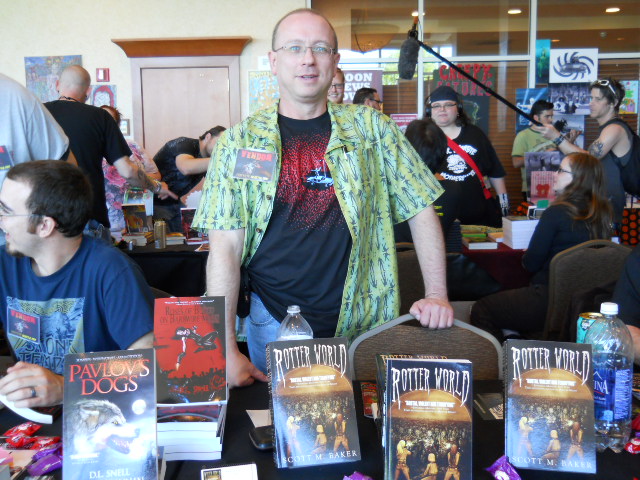 It has taken me almost a week to get caught up, so I wanted to take a
few minutes to post about last weekend's Crypticon convention in
Seattle.
It has taken me almost a week to get caught up, so I wanted to take a
few minutes to post about last weekend's Crypticon convention in
Seattle. It was a tedious trip out to the west coast. I left Washington D.C. at 7:00 AM, flew five hours out to Long Beach where I then suffered through a five-hour layover (and for anyone who has ever been through Long Beach Airport, you know how little there is to do there), and then completed the final two-hour jaunt up to Seattle. I checked into my hotel after nearly fifteen hours on the road, arriving about an hour before my first panel session. But the seemingly endless trip was definitely worth it.
I sat on the usual zombie panels. "Are You Ready for the Zombie Apocalypse? Do You Plan To Survive?" is always fun because I love to compare bug out versus hunker down strategies, and I always pick up some good survivalist tips. (And thanks to Tony Favile for all his great advice.) "Zombies: Why the Fuck Won't They Die?" took a good-natured look at why the living dead not only have remained so popular in our culture but have not witnessed several break away subgenres as vampire fiction has. And there were numerous groans of protest when I mentioned the concept of sparkling zombies. (I promise that is not the plot of my next novel.) And it was an honor and a thrill to join my fellow authors at the Permuted Press Q&A session on Friday night and the joint reading on Sunday.
 |
| Me and Ricou Browning |
By the far the best part of the entire convention was sitting at the Permuted Press table. It's a great publishing house, and I'm excited to be a part of the Permuted family. Thanks to Jacob Kier, the publisher, for inviting me. Many thanks to the other Permuted authors who made me feel so welcome: D.L. Snell, Tony Favile, Craig DiLouie, Timothy W. Long, Gareth Wood, Peter Clines, Eloise J. Knapp, and Jessica Miegs. And many thanks to Tony for introducing me to "sweetened Coke."
I came home exhausted (my flight back into Washington landed at 4:40 AM), but had an epic time and am looking forward to attending in 2013. The next stop for me on the convention circuit is Infect Scranton 21-23 September where several Permuted Press authors will also have a table. Hope to see you there.
 |
| The Permuted gang at Crypticon. From left to right: D.L. Snell, Tony Faville, me, Craig DiLouie, Timothy Long, Gareth Wood, Peter Clines, Eloise J. Knapps (holding the assault rifle), Jacob Kier, and Jessica Miegs. |
Friday, June 1, 2012
SEX AND THE SINGLE ZOMBIE by Lane Adamson
Ha. Made you look.
Zombies--dead that rise and feast upon the flesh of the living, ghouls, to be more technically accurate--are all the, um, rage (as it were) nowadays. From the recordbreaking ratings of The Walking Dead on AMC to the bestselling (and soon-to-be Brad Pitt cinema vehicle) World War Z by Max Brooks, way back to the effective progenitor of this "generation" of the genre, George A Romero's Night of the Living Dead (and its sequels, and the remakes of each)--what is it about these grisly creatures and their ghastly antics that so captures the imaginations of so many?
As I see the zombie story (we'll stick with the Z-word because that's the familiar term, right or wrong), it's all about nihilism. Which is a 50-cent word that bears definition (credit American Heritage Dictionary):
nihilism [( neye -uh-liz-uhm, nee -uh-liz-uhm)]
An approach to philosophy that holds that human life is meaningless and that all religions, laws, moral codes, and political systems are thoroughly empty and false. The term is from the Latin nihil, meaning “nothing.”
In a nutshell, that pretty well explains the ending of Night of the Living Dead. (If you haven't seen it, I won't spoil it. But go see it. Right now. I'll wait for you to come back. All done? Good.) I've embraced this... ethos, for want of a better word, wholeheartedly in my own zombie writing; first and foremost in my approach to the subject is that there are no happy endings, ever.
How can there be? Think about it. The world as we know it has been decimated (or worse) by whatever apocalyptic scenario it is that has brought corpses, I SAID DEAD FREAKING CORPSES, JESUS H TAPDANCING CHRIST DID YOU HEAR ME, shambling to life and eating the faces off your friends, neighbors, and family.
Many of these godawful undead face-eaters are, in fact, your friends, neighbors, and family. And the only way to keep them from eating your face is to shoot them in the head, or whack them in the noggin with a machete, or otherwise do something nasty, gory, and devastating to what passes for a brain in what's left of their mouldering zombie skull.
Face it. There's just no way this ends well. The best one could hope for is to die peacefully in your sleep and then have your house burn down with you in it, before your remains rise to become one of the face-eaters. How in the name of Harold Robbins did this sort of thing become the stuff of best sellers and big box office, anyway?
That's a darned good question, little one. Why don't you go and ask your Mother?
Zombies--dead that rise and feast upon the flesh of the living, ghouls, to be more technically accurate--are all the, um, rage (as it were) nowadays. From the recordbreaking ratings of The Walking Dead on AMC to the bestselling (and soon-to-be Brad Pitt cinema vehicle) World War Z by Max Brooks, way back to the effective progenitor of this "generation" of the genre, George A Romero's Night of the Living Dead (and its sequels, and the remakes of each)--what is it about these grisly creatures and their ghastly antics that so captures the imaginations of so many?
As I see the zombie story (we'll stick with the Z-word because that's the familiar term, right or wrong), it's all about nihilism. Which is a 50-cent word that bears definition (credit American Heritage Dictionary):
nihilism [( neye -uh-liz-uhm, nee -uh-liz-uhm)]
An approach to philosophy that holds that human life is meaningless and that all religions, laws, moral codes, and political systems are thoroughly empty and false. The term is from the Latin nihil, meaning “nothing.”
In a nutshell, that pretty well explains the ending of Night of the Living Dead. (If you haven't seen it, I won't spoil it. But go see it. Right now. I'll wait for you to come back. All done? Good.) I've embraced this... ethos, for want of a better word, wholeheartedly in my own zombie writing; first and foremost in my approach to the subject is that there are no happy endings, ever.
How can there be? Think about it. The world as we know it has been decimated (or worse) by whatever apocalyptic scenario it is that has brought corpses, I SAID DEAD FREAKING CORPSES, JESUS H TAPDANCING CHRIST DID YOU HEAR ME, shambling to life and eating the faces off your friends, neighbors, and family.
Many of these godawful undead face-eaters are, in fact, your friends, neighbors, and family. And the only way to keep them from eating your face is to shoot them in the head, or whack them in the noggin with a machete, or otherwise do something nasty, gory, and devastating to what passes for a brain in what's left of their mouldering zombie skull.
Face it. There's just no way this ends well. The best one could hope for is to die peacefully in your sleep and then have your house burn down with you in it, before your remains rise to become one of the face-eaters. How in the name of Harold Robbins did this sort of thing become the stuff of best sellers and big box office, anyway?
That's a darned good question, little one. Why don't you go and ask your Mother?
Subscribe to:
Posts (Atom)